You're publishing content. You're doing the work. But a competitor you know is weaker than you somehow outranks you for half your target keywords. Sound familiar?
The answer is almost always a content gap — a keyword or topic your competitors rank for that you haven't covered. A content gap analysis is the process of finding those gaps and turning them into a publishing roadmap.
This guide walks you through the exact process we use at Maison Digital to grow organic traffic for our clients, from zero to hundreds of thousands of monthly visitors.
A content gap analysis identifies keywords and topics that your competitors rank for in search results, but your site doesn't. These are opportunities sitting on the table — searches happening right now that could be sending visitors your way, but aren't, because you haven't addressed them yet.
It's distinct from a general keyword research exercise. Instead of starting from scratch, you're using competitor rankings as a shortcut to find proven demand. If a keyword is already sending traffic to someone else, you know the audience exists.
Two things have changed the stakes of content gap analysis in recent years. First, Google's E-E-A-T framework (Experience, Expertise, Authoritativeness, Trustworthiness) now rewards topical depth and completeness over isolated keyword targeting. If you cover 40% of the topics in your niche while a competitor covers 80%, Google reads that disparity — and ranks accordingly.
Second, AI Overviews and generative search results increasingly pull from sites that have comprehensive, well-linked topic clusters. If you're missing foundational content, you won't just lose rankings — you'll be invisible in AI-generated answers too.
You don't need expensive tools to run a content gap analysis, but the right software makes the process significantly faster. Here's what we use:
For this walkthrough, we'll reference Ahrefs, but the same logic applies in Semrush or any comparable tool.
Your SEO competitors are not necessarily your business competitors. They're the sites ranking for the keywords you want — and they might be media sites, review aggregators, or other agencies, not just direct competitors in your industry.
To find them, type your most important target keyword into Google and note the top 5–10 organic results. Those sites are your content competitors for that topic. Do this for 3–5 of your core keywords and you'll see the same 4–6 sites appearing repeatedly. Those are the ones worth analyzing.
In Ahrefs, you can also go to Site Explorer → Competing Domains to get a data-driven list of sites with the most keyword overlap with yours.
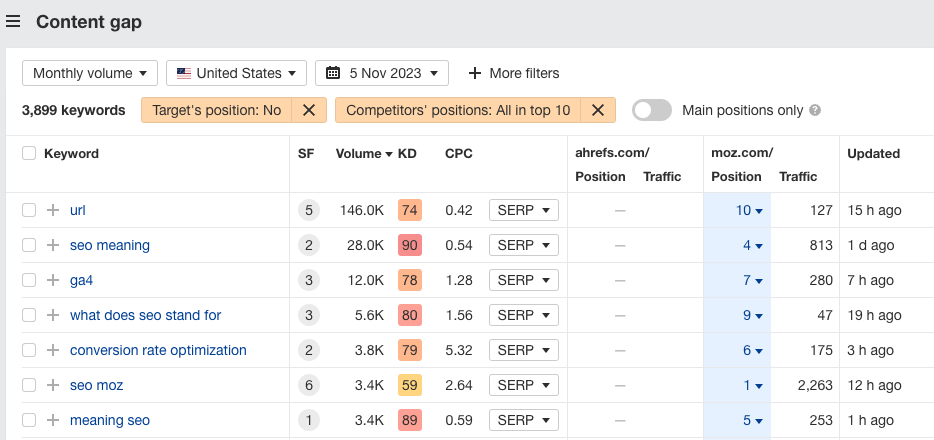
In Ahrefs, navigate to Site Explorer → Content Gap. Enter your domain in the top field, then add 3–5 competitor domains below it. Set the filter to show keywords where at least one competitor ranks in the top 10 but you rank below position 10 or not at all.
Export the results. A typical site will surface anywhere from a few hundred to tens of thousands of gap keywords. Don't panic — the next step is about filtering this down to what actually matters.
Not every gap keyword is worth pursuing. Use these filters to focus your energy:
After filtering, most sites are left with 50–200 high-priority gap keywords. That's your initial target list.
One blog post can rank for dozens of related keywords. Rather than writing one article per keyword, group semantically similar terms together. For example:
Topic ClusterPrimary KeywordSupporting KeywordsContent planningcontent calendar templateeditorial calendar, content schedule, blog planningOn-page SEOhow to write meta descriptionsmeta description examples, meta tag SEO, title tag best practicesLocal visibilityGoogle Business Profile optimizationGoogle My Business tips, local SEO checklist, GMB ranking factors
Each row above becomes one blog post that targets the primary keyword but naturally incorporates the supporting ones. This is how you turn 150 gap keywords into a 20-post editorial calendar.
Not all gaps are equally urgent. Prioritize publishing in this order:
For each article, make sure you're writing content that genuinely outperforms what's already ranking — not just matching it. That means going deeper, including original data or examples where possible, and optimizing for the search intent (informational, navigational, commercial, or transactional) behind each keyword.
Once published, add each URL to Google Search Console and track impressions and clicks weekly. Most pages take 3–6 months to reach their full ranking potential, but you'll start seeing movement within 6–8 weeks if your site has baseline authority.
Repeat this analysis every quarter. Your competitors are creating new content too — new gaps open constantly.
A content gap analysis is the most efficient way to build an editorial calendar that's grounded in real search demand, not guesswork. Instead of asking "what should we write about?", you're asking "what proven demand are we missing?" — and that's a much better question.
Done quarterly, this process compounds. Each gap you close reduces your competitors' advantage and strengthens your own topical authority, making future content easier to rank. To see how we've put this into practice, take a look at our client case studies or explore our full range of digital marketing services.
Need help running a content gap analysis for your site? Get in touch with the Maison Digital team.