Here's what we see on almost every discovery call: a business owner pulls up their Google Business Profile, points to the five-star rating, and asks why they're still not showing up in the map pack. The rating isn't the problem. What's missing is usually buried three menus deep: an unselected secondary category, a service list that hasn't been touched since 2022, or a primary category that was set once during verification and never revisited.
Google Business Profile optimization gets treated like a one-time setup task. It isn't. It's an ongoing input into a ranking system that weighs relevance, distance, and prominence, and most businesses are only half-finishing the "relevance" part before walking away. This guide is the checklist we actually run when we onboard a new local client, including the steps that don't get mentioned in the generic "claim your listing" posts, the same Local Business Marketing process we use with every new account.
For years, GBP was treated as a directory listing: fill it out once, forget it, focus your energy on the website. That thinking is now actively costly.
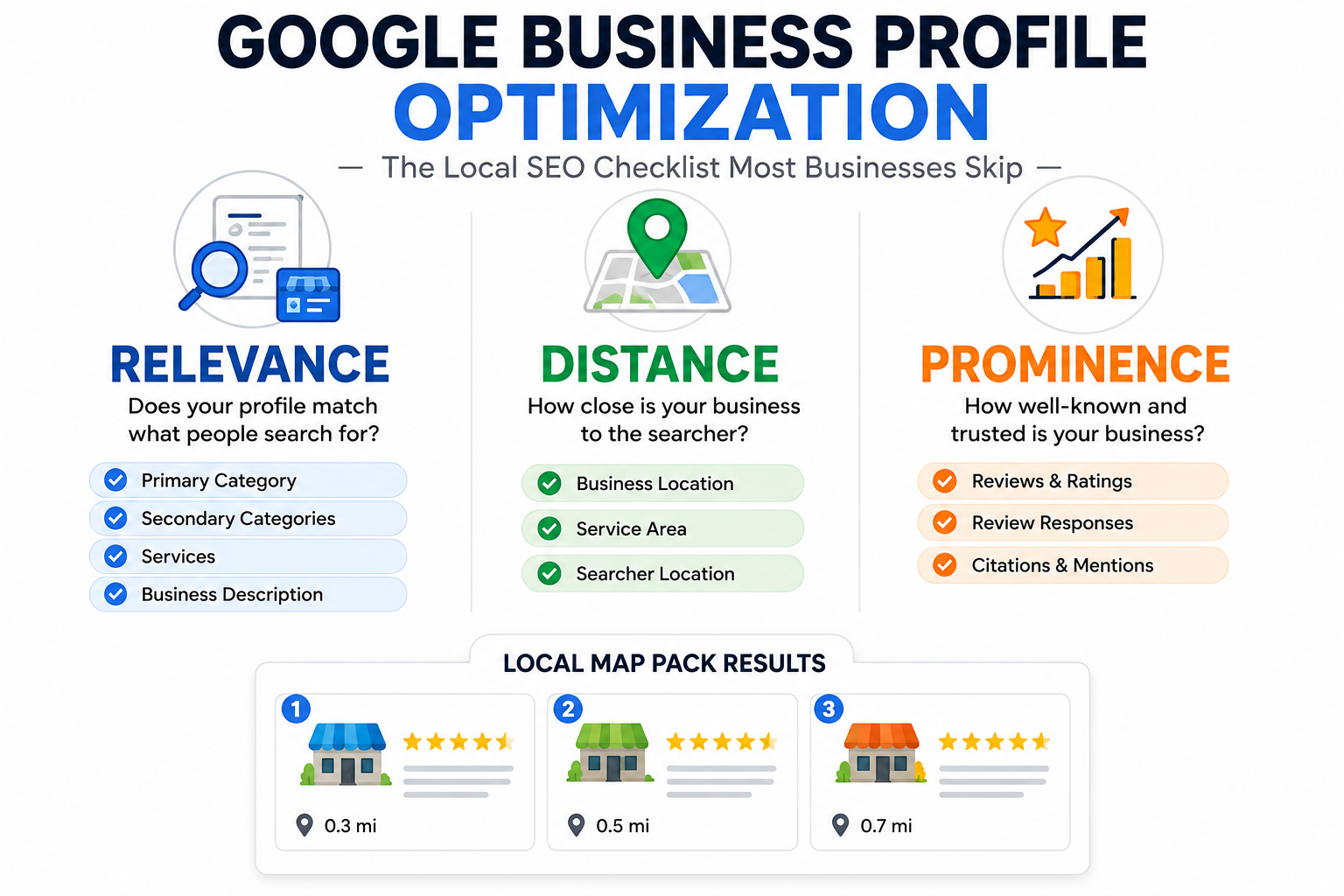
Google has been explicit for years that local ranking comes down to three factors: relevance, distance, and prominence, with prominence meaning how well-known a business is, based on signals like how many websites link to it and how many reviews it has. Distance you can't control. Relevance and prominence, you can, and GBP is where most of that signal gets built or lost.
The competitive gap has also widened. Whitespark's Local Search Ranking Factors survey has consistently found that local search experts rank the primary GBP category as the single most influential factor for local pack rankings, ahead of on-page SEO, backlinks, and review volume. That finding held again in the most recent edition: the 2026 Local Search Ranking Factors survey, released in November 2025, again identified primary category as the top factor influencing rankings in Google's Local Pack.
Reviews matter more than they used to as well. Localo's analysis of roughly two million Google Business Profile pages found that businesses appearing in the top three local pack positions average close to 250 reviews, while businesses ranking four through ten average under 200. That's not a rounding error. It's a visible floor.
Key insight: Category selection and review volume aren't "nice to have" extras. According to the industry's most cited local ranking survey, they're the two biggest levers most businesses aren't pulling hard enough.
Before getting into the full checklist, it's worth naming the four mistakes we find most often when auditing an existing profile, because these are rarely about effort. They're about not knowing the step exists.
This is the sequence we run for every new client engagement. It's ordered by impact, not alphabetically.
| Step | Action | Why It Matters |
|---|---|---|
| 1 | Claim and verify the listing (single listing only) | Duplicate or unverified listings split authority and confuse Google's matching |
| 2 | Set the correct primary category | Consistently ranked as the top local pack ranking factor in industry surveys |
| 3 | Add all relevant secondary categories | Expands the range of queries your profile can match |
| 4 | Standardize NAP (name, address, phone) across GBP and website | Inconsistent NAP is one of the most common causes of suppressed rankings |
| 5 | Write a complete, keyword-aware business description | Gives Google additional context beyond category taxonomy |
| 6 | Add services and products with descriptions | Signals depth of offering, not just category membership |
| 7 | Upload and maintain photos (minimum monthly) | Google reports that businesses with photos get 42% more requests for driving directions and 35% more clicks through to their websites than those without |
| 8 | Enable messaging and respond promptly | Response time is a visible trust signal to prospective customers |
| 9 | Build a review generation process | Review volume and velocity both correlate with top-three placement |
| 10 | Respond to every review, positive and negative | Response behavior is a prominence and trust signal, not just customer service |
| 11 | Post updates on a consistent cadence | Recency of activity is treated by Google as a freshness signal |
| 12 | Monitor and correct Q&A entries | Unmoderated answers can misinform customers and go unnoticed for months |
Most of these twelve steps are quick wins once you know to look for them, but categories and reviews are where the real ranking movement happens, and where our local SEO services spend the most time on a new account.
Category selection is the step we spend the most time on with new clients, because it's where the biggest wins hide. Google's own category list runs into the thousands, and many are more specific than businesses assume: "Deck Builder" instead of "General Contractor," for example, if that's genuinely a core service.
The mistake we see constantly: businesses pick the broadest category that technically applies, assuming broader means more visibility. It's the opposite. A narrower, accurate primary category tends to outrank a broad one for the specific searches that actually convert, because it signals a tighter relevance match.
Business profiles with photos receive roughly 30 to 50% more views than those without, and listings with ten or more photos can see up to double the engagement of profiles with only a handful. What's less discussed is that the average local service business is nowhere near that threshold. Most profiles we audit have fewer than ten total photos, often several years old.
Our standard recommendation: add at least one new photo every week for the first quarter of an engagement, then settle into a monthly cadence. Prioritize completed jobs, team photos, and the storefront or vehicle, not stock imagery. Google's systems and prospective customers both respond to evidence of a real, active business.
Review strategy is where we see the widest range of business owner assumptions. The most common one: "we have great reviews, so we're fine." Volume matters as much as sentiment.
Businesses ranking eleventh through twentieth in local search average just over 150 reviews, compared to nearly 250 for businesses in the top three, a gap that reinforces why an ongoing review generation process (not a one-time push) belongs in the core optimization checklist rather than as an afterthought.
Responding to reviews, all of them, is the piece that gets skipped most often, particularly negative ones. A thoughtful, non-defensive response to a critical review often does more for conversion than another five-star review, because it's the proof point prospective customers actually read before calling. This is one of the most common gaps we flag in a Google Business Profile audit, and usually the fastest one to fix.
| Area | Unoptimized Profile | Fully Optimized Profile |
|---|---|---|
| Categories | Primary only, often too broad | Primary (specific) + relevant secondary categories |
| Photos | Under 10, outdated | Monthly additions, 25+ current photos |
| Description | Generic or missing | Specific, keyword-aware, human-readable |
| Reviews | Passive collection, no response process | Active generation process, 100% response rate |
| Posts | Rare or none | Consistent weekly or biweekly cadence |
| Q&A | Unmonitored | Reviewed and corrected regularly |
| Map pack visibility | Inconsistent, rank fluctuates | Stable top-three presence for core terms |
Consider a mid-sized HVAC company, a composite of clients we've worked with: single location, established ten years, decent reputation, invisible in the map pack for anything beyond their exact business name. The profile had one category ("HVAC Contractor"), fourteen photos all from a single photoshoot years earlier, and a review response rate near zero.
The fix wasn't exotic. We added four relevant secondary categories covering specific services (furnace repair, AC installation, duct cleaning, thermostat installation), rewrote the business description to name the service area and core offerings explicitly, and put a review request into the standard post-service workflow via text message. Photos went from fourteen static images to a rolling monthly upload of completed jobs.
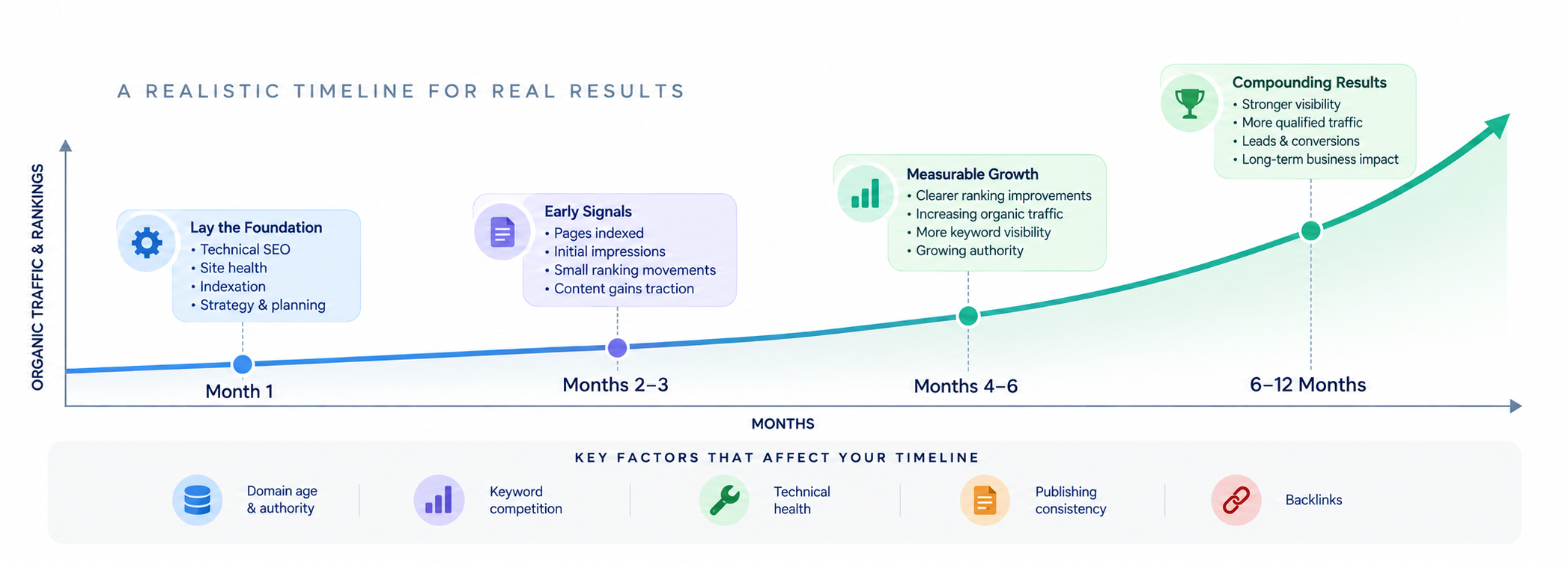
None of this required new backlinks, new content on the website, or paid spend. Within a local SEO cycle, which typically runs eight to twelve weeks before ranking shifts stabilize, the business moved from inconsistent map pack appearances to a stable top-three position for its primary service terms in its service area. This is a directional example of how the mechanics play out, not a guaranteed timeline. Individual results depend on competition density and market size, which is why we review comparable local engagements with every new client before setting expectations.
Open your profile and work through four things. Check whether your primary category is the most specific one that fits, and add every secondary category that matches a service you sell. Count your photos and upload five recent ones. Reply to your ten most recent reviews. Read the Q&A section and correct anything that's wrong.
Then book 20 minutes a month to repeat the photo, review, and Q&A pass, and add a review request to whatever message you already send after a job. If rankings haven't moved after eight to twelve weeks, look for a duplicate listing, a category mismatch, or a directory showing an old address or phone number.
Get a free Google Business Profile audit, and we'll walk your listing against this exact checklist, flag what's costing you visibility, and show you the specific fixes worth prioritizing first.


.png)