Almost every content team we talk to has already adopted AI writing tools. Adoption isn't the question anymore. HubSpot's 2026 State of Marketing report puts AI content creation adoption at roughly 80%, with the share of marketers creating blog content without any AI assistance dropping from 65% to just 5% over two years. The question we hear now is different, and harder: why does so much of that content still read like nobody was home?
The honest answer is that most teams adopted the tool without redesigning the workflow around it. They swapped a blank page for a first draft and called it a process. In our experience running content operations for clients across multiple industries, the teams getting real value from AI copywriting tools aren't the ones prompting the hardest. They're the ones who've been deliberate about which parts of content production to hand off, and which parts still require a person who knows the subject, the audience, and the brand, the same distinction we build into every AI copywriting engagement we run.
This is a practical framework for that decision, not another list of tool recommendations.
There's a version of this conversation from two years ago that treated AI content adoption as a binary: either you use it and move fast, or you don't and fall behind. That framing is dead. HubSpot's 2026 data found that more content is now generated by AI than by humans, but most of it is average, and 56% of marketers say the internet is flooded with AI-generated content, while 65% say consumers are getting better at spotting and ignoring it. Volume stopped being the differentiator the moment everyone had access to the same tools.
We think the industry has quietly reached a second inflection point. The competitive advantage isn't having AI in your stack anymore: that's table stakes. It's having a workflow disciplined enough to keep AI's weaknesses from reaching the reader. Teams that skip that step aren't publishing content marketing anymore. They're publishing noise with a byline.
There's also a search-visibility angle that raises the stakes. Google has been consistent that its concern isn't AI authorship itself. It's low-value content produced at scale to manipulate rankings, regardless of how it was written. Google's own guidance frames this as evaluating content on quality and usefulness rather than production method, which means an AI-assisted article with genuine expertise behind it competes on equal footing with a human-written one, and a thin AI draft with no editorial layer loses to both.
That distinction, production method versus editorial quality, is the entire premise of a well-designed AI copywriting tool workflow. The tool doesn't determine the outcome. The process around it does.
Let's be specific, because "AI speeds things up" is too vague to build a process around. In practice, AI writing tools for marketing consistently outperform a blank-page human draft in a narrow set of tasks.
| Task Type | What AI Handles Well | Why It Works |
|---|---|---|
| First-draft structure | Turning a brief, outline, or set of talking points into a coherent draft with logical section flow | Biggest time savings live here, not in final prose quality, but in eliminating the blank-page problem |
| Repurposing existing content | Turning a long-form article into social captions, an email blurb, or a shorter variant | The source material already carries the expertise; AI is just reshaping the format |
| Research synthesis and outlining | Pulling together a starting structure from a topic brief | Gives a writer a starting point instead of a blank document |
| Volume tasks with low creative ceiling | Product descriptions at scale, meta descriptions, alt text, internal FAQ drafts | Consistency matters more than voice for this content type |
| Editing assistance | Catching redundancy, tightening sentences, flagging passive voice | This is the mechanical layer of editing, not the judgment layer |
Notice what's common across all five: none of them require the tool to know anything true about your business, your customer, or your market that isn't already in the prompt. AI is compressing time on tasks that are fundamentally about assembly, not judgment.
This is the part most "AI content workflow" guides gloss over, usually because it's less exciting than the automation pitch. Here's where we've found AI consistently falls short, and it's not a training-data problem that gets solved by the next model release. It's structural.
AI tools generate plausible-sounding sentences about what "works" in a given industry. They have no actual campaign history, no client relationships, and no memory of what specifically failed last quarter. When an article claims something works "in our experience," that claim needs to be true, or it erodes the exact authority the article is trying to build. Google's Quality Rater Guidelines explicitly weight first-hand experience as part of E-E-A-T; content that only sounds experienced doesn't pass that bar with either readers or search evaluators.
AI models can fabricate statistics with total confidence, attribute quotes to the wrong person, or cite a "study" that doesn't exist. This isn't a rare edge case. It's a known, persistent limitation. Every number, every named source, and every "according to" needs a human to verify it against the original before it goes live.
Generic AI phrasing is easy to spot: safe hedging, vague enthusiasm, and a refusal to take a position. A subject-matter expert reviewing a draft will catch not just typos, but the places where the piece is technically correct and says nothing: where a real practitioner would take a stance, and the AI draft played it safe instead.
AI doesn't know which competitor you're quietly differentiating from, which objection your sales team hears every week, or which claim your legal team flagged last quarter. That context lives with the team, not the tool.
Key insight: The failure mode isn't "AI wrote something wrong." It's "AI wrote something plausible, and nobody checked." The workflow has to make checking unskippable, not optional.
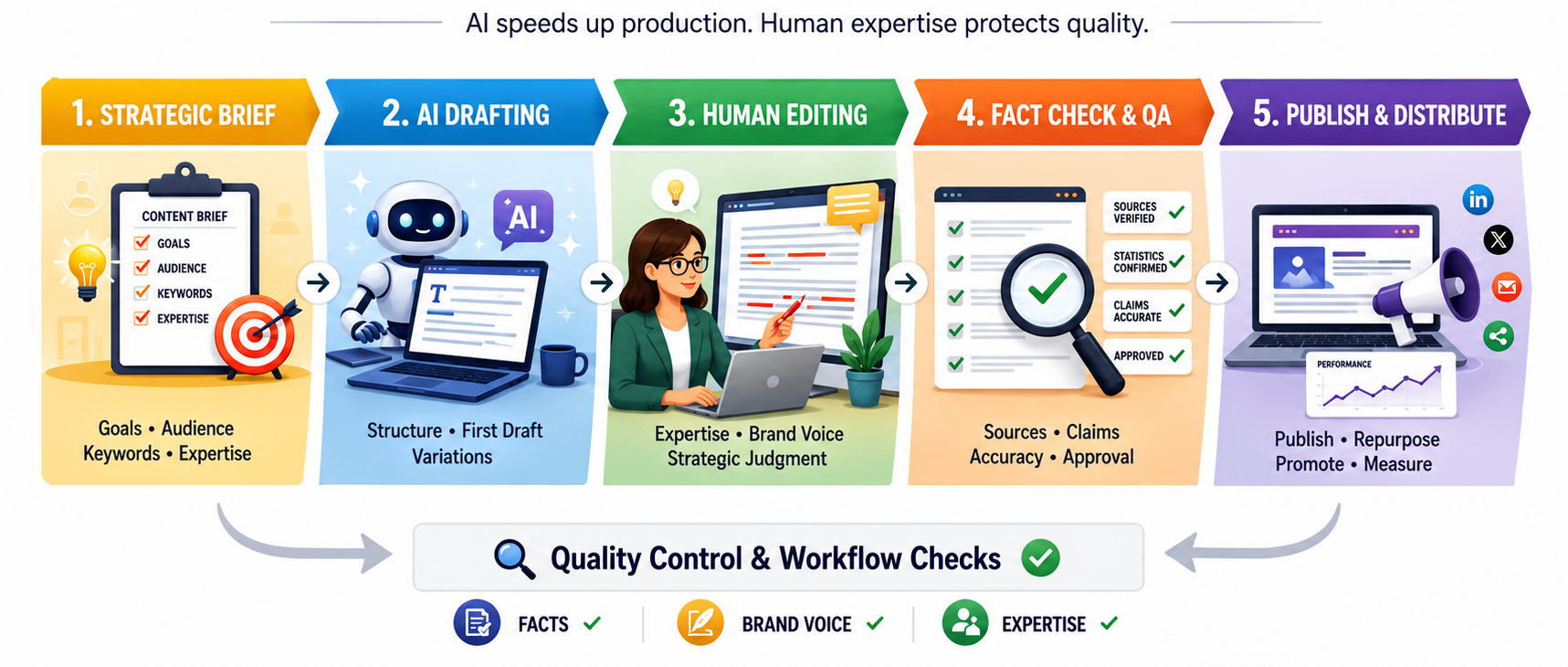
Here's the structure we recommend building into a content production workflow. It assumes AI is used for drafting, but treats every draft as unverified until it clears four distinct checkpoints.
| Layer | What Happens | Who Owns It | What It Catches |
|---|---|---|---|
| 1. Brief & context | Human writes the brief: audience, angle, POV, what NOT to say | Content strategist | Generic framing, missing brand context |
| 2. AI-assisted draft | AI generates structure and first-pass copy from the brief | Writer + AI tool | Blank-page delay, structural inconsistency |
| 3. Fact and source check | Every statistic, study, and named source verified against the original | Editor or researcher | Fabricated stats, misattributed quotes |
| 4. Expert and voice review | Subject-matter expert adds first-hand insight; edits for voice and position | Senior strategist or SME | Generic phrasing, missing expertise, brand-voice drift |
Skip Layer 1, and the AI has nothing distinctive to work from. You get generic output because you gave it generic input. Skip Layer 3 or 4, and you get exactly the "flooded with AI content" article Google and HubSpot's data both point to as the problem, not the solution.
Take a common scenario: a B2B services company wants to publish weekly. Prior to adopting an AI content review process, their bottleneck was drafting: a writer spent most of a week producing one article, leaving almost no time for promotion or repurposing.
After restructuring the workflow around the four-layer model above, the bottleneck moved. Drafting time dropped substantially because the AI tool handled structure and first-pass copy from a detailed brief. But the fact-check and SME review layers didn't shrink. If anything, they got more rigorous, because now every draft needed a human to confirm the AI hadn't quietly invented a statistic or smoothed over a real nuance the SME actually cared about.
The net result: the team didn't publish faster in a way that sacrificed quality. They published at the same cadence, with the review time reallocated to strategy and promotion instead of first-draft assembly. That's the actual ROI of an AI-assisted workflow: not less human involvement, but human involvement moving to the parts of the process where it's irreplaceable.
| Question | If "no," here's the risk |
|---|---|
| Does every draft start from a brief with a specific POV, not just a topic? | Generic output, indistinguishable from competitors' AI drafts |
| Is fact-checking an assigned step with a named owner? | Fabricated stats or misattributed quotes reach publication |
| Does an SME review every draft for first-hand insight before it publishes? | Content reads as technically correct but expert-free |
| Do you track which pieces get cited, linked, or ranked over time? | No feedback loop to tell you which workflow layers are working |
| Is your brand voice documented with real examples, not a style-guide paragraph? | Every draft needs tone correction from scratch |
If more than one of these is a "no," the workflow, not the tool, is where the gap is.
Run the self-audit above against your last five published pieces. Most teams find the same two gaps: nobody owns fact-checking, and briefs name a topic without a point of view. Fix those before anything else. Put one person's name next to the fact-check step, and add three lines to your brief template: the position we're taking, what we won't say, and one thing we know from our own client work.
Hold the next month of content to that process and watch how much rewriting the final review needs. If that number drops, the workflow is doing its job.
If your team has adopted AI writing tools but isn't seeing the quality or efficiency gains you expected, the gap is almost always in the review layers, not the drafting layer. That's a workflow problem, and it's a fixable one. Talk to us about building an AI-assisted content workflow that gets the speed benefits without the generic-content risk.


.png)