Most marketing directors we talk to aren't struggling to produce more content. Their teams have never shipped faster. What they're struggling with is that a growing share of what ships reads like it came from nowhere in particular: competent, on-topic, and utterly indistinguishable from what every competitor's AI tool is also producing. That's not an AI problem. It's an AI content production brand voice problem, and it comes down to workflow discipline, not model selection.
We've rebuilt content operations for clients who came to us after "AI-izing" their production and watching engagement quietly erode. The tools weren't the issue. The absence of guardrails was. This piece lays out the framework we use to help teams scale content production with AI while keeping the voice that made their content worth reading in the first place.
Every large language model is trained on an enormous, averaged-out corpus of internet writing. Left unguided, it will default to the statistical center of that corpus. That's precisely why unedited AI output tends to converge on the same rhythms, the same three-item lists, the same "in conclusion" wrap-ups, regardless of which vendor's model produced it. It's not a bug you can prompt your way out of entirely. It's the mechanism.
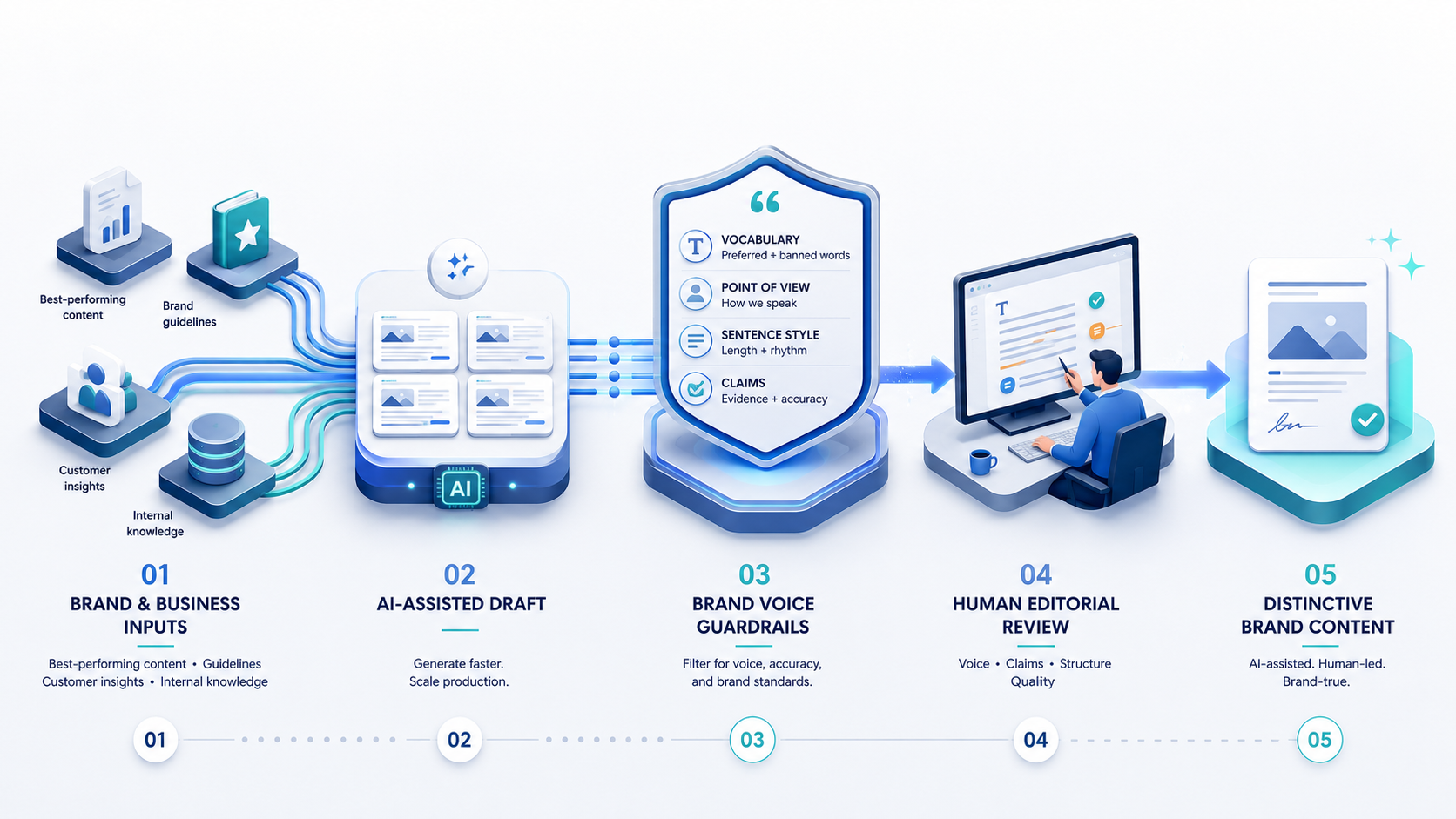
Brand voice, by contrast, lives in the deviations from that center: the specific words a company avoids, the length of its sentences, the way it handles a customer objection, the point of view it's willing to take that a competitor wouldn't. None of that is implicit in a generic prompt. It has to be explicitly engineered into the workflow, at the input layer, the editing layer, and the review layer, or the model will quietly sand it off.
Most brand guidelines documents list adjectives: "friendly, confident, authoritative." Adjectives are nearly useless as AI inputs because they're vague enough that any output can be argued to fit them. What actually constrains an AI system's output is:
The economics of content have flipped. When producing a blog post took a skilled writer six hours, volume was naturally rationed and differentiation was a secondary concern. Scarcity did some of the work. Now that a first draft takes minutes, volume is no longer the constraint. Differentiation is the entire game, and the data backs that up from multiple directions.
HubSpot's 2026 State of Marketing research found that 42.5% of marketers now use AI extensively in content creation, with another 38% using it occasionally. That means AI touches the vast majority of marketing content in some form. Yet in the same research, 62.7% of respondents said the market needs "more unique, human-centered content to compete with AI content." Marketers are simultaneously the biggest adopters of AI content tools and the most vocal about the sameness problem those tools create when left unmanaged (HubSpot, 2026 State of Marketing).
Search performance backs this up from a different angle. Semrush's research on AI content and rankings found that purely human-written content still occupies the #1 organic position 80.5% of the time, versus roughly 10% for unedited AI content, even though 72% of SEO professionals surveyed believed AI content ranked just as well. The gap narrows further down the results page, but at the position that drives the most clicks, distinctiveness and depth still win. Notably, 87% of the SEO teams in that study keep humans directly in the content production loop, and 64% describe their process as "human-led, AI-assisted." That's a ratio worth internalizing before assuming AI can run content unattended (Semrush, "Does AI Content Rank Well in Search?").
Google's own public guidance reinforces the same principle from the platform side: the company has repeatedly stated that its systems reward content demonstrating experience, expertise, authority, and trust regardless of how it was produced. Content produced primarily to game rankings, with no evidence of genuine expertise or a distinct point of view, is treated as low-quality no matter which tool wrote it. Production method isn't the signal Google is optimizing for; distinctiveness and demonstrated expertise are.
The Content Marketing Institute's 2026 B2B research adds a sharper warning about the ceiling on AI-only content. In their survey, 95% of B2B marketers now use AI-powered tools and 89% use them specifically for content generation, but only 58% report that content quality actually improved as a result, and 12% report it got worse. The biggest lever for improved content performance wasn't tooling at all; it was "strategy refinement," cited by 74% of respondents, well ahead of technology adoption at 51% (Content Marketing Institute, B2B Content Marketing Trends Research 2026). Read plainly: the organizations getting real value from AI content aren't the ones with the best prompts. They're the ones with the clearest strategic and voice guardrails wrapped around the tool.
The takeaway: AI didn't create a content quality problem. It removed the natural rationing that used to keep low-differentiation content off the internet. Voice discipline is now a competitive lever, not a nice-to-have.
When we onboard a client onto an AI-assisted content workflow, we build guardrails in three layers, in this order. Skipping the first layer is the single most common reason AI content programs stall out sounding flat.
| Layer | What It Controls | Where It Lives |
|---|---|---|
| Input layer | Voice codification, source material, prompt structure | Brand voice document + prompt templates |
| Generation layer | Model selection, temperature/creativity settings, structured outputs | AI tooling configuration |
| Editorial layer | Human review, fact-checking, voice QA, final approval | Editing workflow + sign-off process |
A functional AI content guardrail starts with a voice document that reads more like a style guide than a brand deck: specific enough that two different writers, or a model, would produce recognizably similar output from the same brief. In our experience, the fastest way to build this isn't to write it from a blank page. It's to reverse-engineer it from 15-20 pieces of the brand's best-performing existing content, extracting the patterns that actually appear rather than the ones the team wishes were true.
This is where most teams under-invest. "AI drafts, human edits" sounds like a process, but it isn't one until you define what each pass is actually checking for. We use a four-pass structure:
| Pass | Owner | Primary Question |
|---|---|---|
| 1. Structural edit | Senior editor or strategist | Does the argument hold up? Is the point of view clear and defensible? |
| 2. Voice edit | Brand-trained editor | Does every paragraph sound like this brand, not a generic authority? |
| 3. Fact and claims check | Subject-matter reviewer | Is every statistic, quote, and claim verifiable and correctly attributed? |
| 4. Final approval | Content lead or marketing director | Does this meet the bar we'd publish under our own name? |
Compressing these into a single "read-through" is how generic phrasing survives to publication. A single reviewer skimming for typos isn't positioned to catch voice drift, unverified claims, and structural weakness simultaneously, which is exactly the failure mode our AI copywriting services are built to catch.
Editing after the fact is necessary but expensive at scale. The teams that get the most out of AI content production push voice constraints upstream, into structured prompt templates that reference the codified voice document directly, ban specific phrases outright, and require the model to cite where a claim came from rather than generate one. This doesn't eliminate the need for human editing (nothing does), but it meaningfully reduces how much rewriting the editorial layer has to do, which is what actually makes AI-assisted production faster in a way that holds up over time.
We see the same handful of failure patterns repeatedly, almost regardless of industry.
| Mistake | Why It Happens | The Fix |
|---|---|---|
| Using AI's default tone with no voice input | Team treats the tool as "done" out of the box | Feed the model a codified voice document and banned-phrase list in every prompt template |
| One editing pass focused only on grammar | Editing is treated as proofreading, not brand QA | Separate structural, voice, and fact-checking passes with different owners |
| No one owns "voice" as a deliverable | Voice consistency isn't anyone's explicit KPI | Assign a named brand voice owner who signs off before publication |
| Publishing AI drafts with unverified stats | Speed pressure skips the fact-check step | Require a source link for every statistic before a piece leaves the editorial queue |
| Treating every content type identically | A landing page and a thought-leadership post need different voice registers | Build separate prompt templates and guardrails per content type |
A quick gut check: if you removed your logo from a piece of AI-assisted content, would a regular reader of your blog still recognize it as yours? If the honest answer is "probably not," the input and editing layers need work before the volume dial gets turned up further.
Consider a mid-market B2B SaaS marketing director tasked with tripling blog output on a flat headcount. It's a mandate we hear from prospective clients constantly. The instinctive move is to plug AI into the existing process and let the writers "edit" the output. Within two months, organic engagement metrics (time on page, scroll depth, return visits) start slipping even as publishing cadence triples, because the content, while accurate, has lost the specific point of view that built the blog's audience in the first place.
The fix isn't to slow back down. It's to insert the guardrail framework above: a codified voice document built from the blog's twelve best historical posts, prompt templates that bake in banned phrases and required point-of-view statements, and a four-pass editorial process where a single named editor owns voice sign-off across every post. Output volume stays elevated. Voice-driven engagement metrics recover because the constraint that was missing (not effort, not editing time, but explicit voice codification) gets put back in place, a pattern we've seen repeat across the client engagements documented in our work.
Volume and speed are easy to measure and easy to over-index on. The metrics that actually indicate a healthy AI content production process are different:
Brand consistency isn't a soft metric, either. Marq's (formerly Lucidpress) widely cited State of Brand Consistency research found that companies that maintain consistent brand presentation across channels can see revenue gains of up to 33%. That's a figure worth keeping in mind before treating "the AI drafts sounded a little off" as a minor issue rather than a revenue-relevant one.
Pull the 15 posts that earned the most return visits or replies and read them side by side. Write down what they share: sentence length, how they open, the words they never use, the positions they take. That page is the first draft of your voice document.
Turn it into a prompt template with a banned-phrase list, name one editor who signs off on voice, and run the blind voice test on your next five drafts. If a teammate can't tell your posts from a competitor's with the names removed, tighten the template before you raise the volume.
If your team is producing more AI-assisted content than ever and quietly worried it all sounds the same, that's precisely the gap we help marketing directors close: building the voice guardrails and editorial workflow that let you scale output without diluting what made your brand worth reading in the first place. Schedule a brand voice and AI workflow consultation and we'll walk through where your current process is leaking voice, and what a guardrail framework built around your specific brand would look like.


.png)