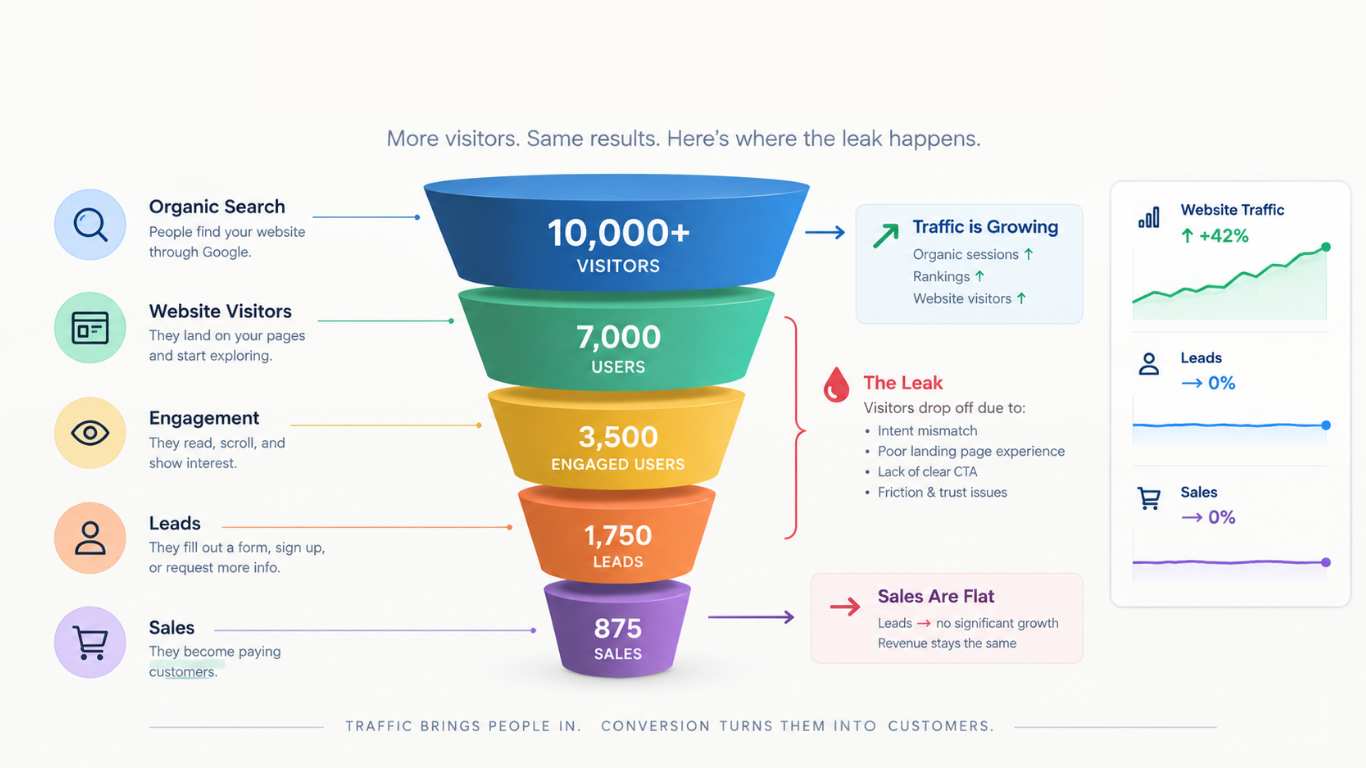
Your traffic graph is up and to the right. Rankings are climbing, organic sessions are growing month over month, and the SEO work is clearly paying off by every metric you can see in Google Analytics. And sales are flat, or worse, quietly declining. If this describes your business, the instinct is to assume SEO isn't working. It usually is. Website traffic growing but sales aren't is rarely an SEO problem at all. It's almost always what happens on the page after someone lands on it, and the gap between those two facts is where a lot of otherwise smart marketing budget goes to die.
This isn't a niche problem. The average website converts somewhere between 2% and 3% of visitors according to 2026 benchmarking from Contentsquare's Digital Experience Benchmark Report, which means the other 97 to 98 out of 100 visitors leave without taking action, even on sites that are doing everything right on the acquisition side. Growing traffic without fixing what happens next just means more people are seeing the leak, week after week, without anyone on the team noticing where the actual money is being left behind.
SEO and conversion rate optimization used to feel like the same job because for a long time, improving one improved the other almost by default. Early-stage SEO wins, better titles, faster pages, cleaner site structure, tend to lift both metrics together. Once those fundamentals are in place, the two metrics decouple. More traffic stops automatically meaning more sales, because the traffic growth and the conversion problem are now unrelated issues competing for the same page.
Key insight: a page can rank perfectly and still fail completely, because ranking measures relevance to a search engine's algorithm, while converting measures persuasion to an actual human being standing between a problem and a decision. Those are different skills, built by different work, and most businesses only staff for one of them.
When traffic climbs but sales stay flat, the cause almost always sits in one of three places. Diagnosing the wrong one wastes a quarter fixing a symptom while the actual problem compounds, and that quarter usually costs more than the audit that would have caught it in the first place.
Most businesses jump straight to fixing the third cause because it's the most visible and the easiest to hand to a developer. In our experience, the first cause, intent mismatch, is usually the bigger revenue leak, and it's the one most teams check last.
Here's the uncomfortable version of this: ranking for a keyword and satisfying the person who typed it are two separate accomplishments, and SEO work optimizes almost exclusively for the first one. A page can be technically excellent, fast, well-structured, backed by strong internal linking, and still convert near zero if it answers a different question than the one the visitor actually had.
This shows up constantly in B2B and service businesses. A page ranking for an informational, "how to" style query pulls in visitors who want to learn something, not buy something, and then gets judged against a sales conversion goal it was never built to hit. The traffic to conversion gap this creates isn't a sign the page failed. It's a sign the page and the goal were mismatched from the start. The fix usually isn't rewriting the content; it's matching the call-to-action to what that specific visitor is actually ready to do, which for an informational page is rarely "buy now."
A related version of this problem shows up when the meta description or title promises one thing and the page delivers another. A visitor who searched for a specific service and landed on a generic overview page notices the mismatch immediately, and that moment of "this isn't quite what I was looking for" erodes trust before they've read a single sentence of your actual pitch.
There's a specific frustration that shows up in this situation: SEO traffic not converting gets blamed on the SEO strategy itself, when the traffic is often doing exactly what it was asked to do. Rankings measure whether Google thinks your page is the best answer to a query. They say nothing about whether your business is the right fit for the person who typed that query, or whether your page gives them a reason to act once they arrive.
This distinction matters because it changes who should be fixing the problem. If your SEO agency is delivering rankings and traffic growth but revenue stays flat, the fix usually isn't a new SEO strategy. It's aligning what happens after the click with what the visitor actually wants next. We've seen accounts where switching agencies over a "traffic isn't converting" complaint solved nothing, because the new agency inherited the same unconverted traffic and the same unfixed landing pages. The traffic wasn't the problem the first time, and it wasn't the second time either.
A useful gut check: pull your top five organic pages by traffic and honestly answer whether each one has a call-to-action that matches what a visitor at that stage is actually ready to do. A blog post ranking for "what is X" shouldn't lead with "buy now." It should lead with a low-commitment next step, a related resource, a newsletter signup, a soft-touch consultation offer, that respects where the visitor actually is in their decision.
This is the sequence we run through with clients experiencing exactly this problem: traffic climbing, revenue flat. Work through it in order; each step rules out one of the three root causes before you spend money fixing the wrong thing.
We walk through this same diagnostic in more depth during a live account review, and cover the CTA and form side of it specifically in our landing page conversion checklist.
One reason business owners misjudge their own gap is comparing their number against the wrong benchmark. A blended "2 to 3% average" is nearly useless without knowing what type of traffic and conversion goal you're actually measuring.
If your relevant category number sits meaningfully below these ranges, you likely have a real gap worth investigating. If it sits within range but revenue still feels flat, the problem may not be conversion rate at all, it may be lead quality, which is a related but separate diagnosis.
A B2B services client came to us with organic traffic up nearly 40% year over year and flat lead volume, convinced their SEO agency wasn't delivering results despite the rankings improving every month. The traffic was real. Their top-performing page, ranking for a specific informational query, was pulling in thousands of qualified visitors monthly.
The problem wasn't the page's SEO performance. It was that the page had a single, buried "contact us" link at the very bottom, aimed at visitors who'd already made a decision, when most of that traffic was still in the research phase. We restructured the page with a mid-funnel CTA offering a lower-commitment next step, a resource download gated behind an email, positioned right where engaged readers naturally paused. Lead volume from that single page increased significantly within the first month, without a single change to the content's SEO performance or a single additional visitor. The traffic had been right all along. It just never had a reasonable next step to take.
Website traffic growing but sales not following isn't usually a sign your SEO strategy is broken. It's a sign your site is winning the acquisition half of the job and losing the conversion half, and those are two genuinely different disciplines that happen to share the same pages. Diagnose the gap before you spend another dollar on traffic growth: check intent alignment first, on-page persuasion second, and technical friction third. Fixing the wrong one first is how quarters get wasted chasing a symptom.
If your traffic keeps climbing and your sales conversations aren't, that gap is diagnosable, and it's usually cheaper to fix than it is to keep growing traffic that never converts.
Ready to find out exactly where your visitors are dropping off? Request a free conversion rate audit and we'll walk through your top pages, your funnel, and the specific fixes worth prioritizing first.