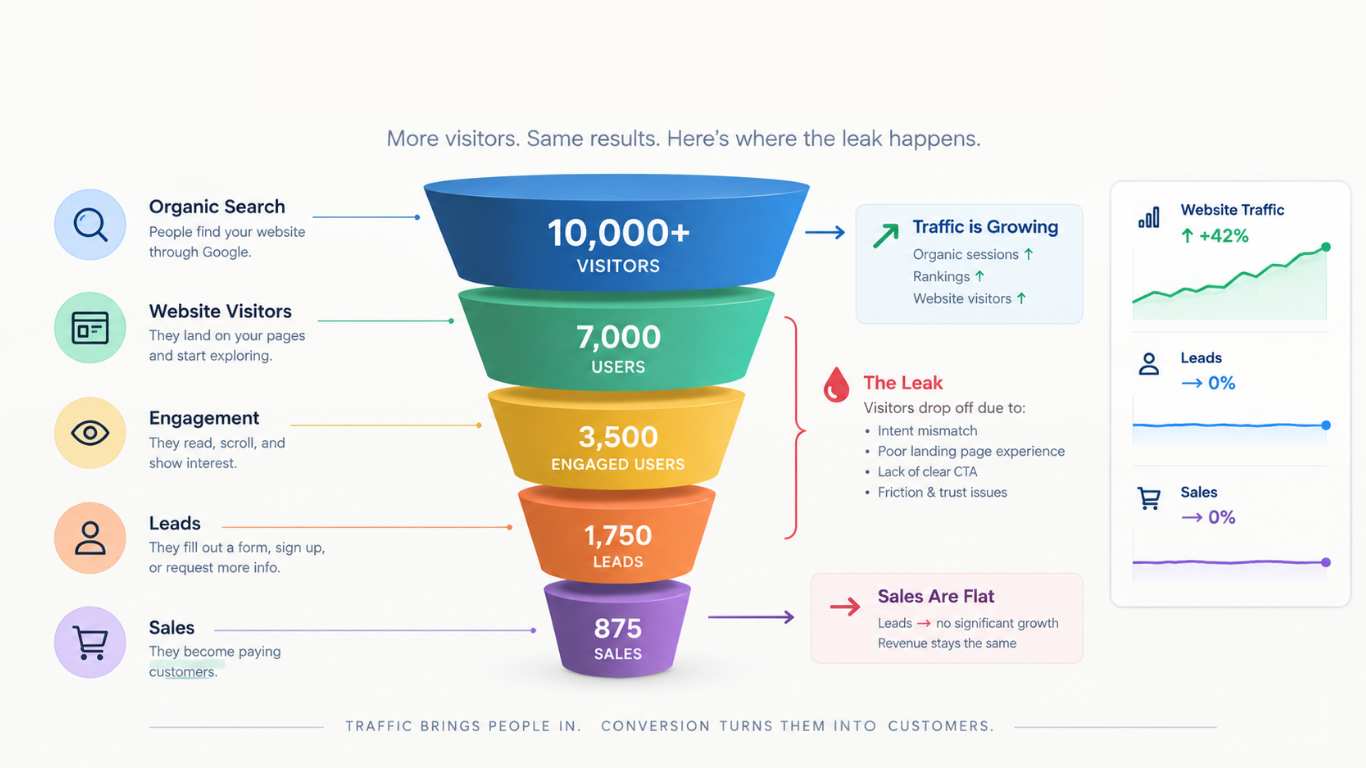
One day your site is ranking on page 1. Then traffic starts falling, leads dry up, and a quick Google check confirms your worst fear — you've dropped several positions, or disappeared from the results entirely.
Before you panic, know this: ranking drops are common, they're almost always diagnosable, and most of them are fixable. The key is identifying the right cause before you start making changes — because the wrong fix can make things worse.
Here are the most common reasons Google rankings drop and what to do about each one.
Google updates its search algorithm thousands of times per year, with several major "core updates" that can significantly shift rankings across large numbers of sites. If your rankings dropped suddenly — especially if it happened around the same time many other sites saw changes — an algorithm update is the most likely culprit.
How to check: Cross-reference your traffic drop date with known Google algorithm updates. Resources like Google's Search Central Blog and sites like Search Engine Roundtable track confirmed update rollout dates.
How to fix it: Core updates are Google's way of better rewarding content that demonstrates genuine E-E-A-T (Experience, Expertise, Authoritativeness, Trustworthiness). There's no quick fix — the response is to audit your content for quality and depth, ensure your authors have visible credentials, and make sure your site is genuinely more helpful than competing pages. Sites that recover from core updates typically do so after the next update, not overnight.
Ranking drops that happen immediately after a site update — a redesign, a migration, a plugin change, or a URL restructure — are almost always caused by that change. This is one of the most common and most preventable causes of ranking drops.
Common culprits:
How to check: Open Google Search Console and check the Coverage report for a spike in "Excluded" or "Noindex" pages around the date of your drop. Also check the URL Inspection tool on specific pages that lost rankings.
How to fix it: Identify which change caused the drop and reverse or correct it. If URLs changed without redirects, implement 301 redirects from old URLs to new ones immediately. If pages were accidentally noindexed, remove the noindex tag and request indexing via Search Console.
Backlinks — links from other websites pointing to yours — are one of Google's most important ranking signals. If a high-authority site that was linking to you removed that link, or if a large number of links were lost at once (due to a site going offline, for example), your rankings for the pages those links supported can drop significantly.
How to check: Use Google Search Console's Links report or a tool like Ahrefs to check your backlink profile. Sort by lost links and look for any significant drops around the time your rankings fell.
How to fix it: If you lost a link from a specific high-value site, reach out to the site owner and ask if it can be reinstated. More broadly, the long-term fix is building a diverse, high-quality backlink profile so your rankings aren't dependent on any single link source.
Sometimes your rankings drop not because anything went wrong on your site, but because a competitor published or updated content that now outperforms yours. Google is always comparing your page against competing pages — and if theirs got better while yours stayed the same, they move up and you move down.
How to check: Search for the keywords you've lost rankings for and look at what's now ranking above you. Is the competing content longer? More recent? Does it cover angles or questions your content doesn't?
How to fix it: Update and expand your content. Add sections that address questions the top-ranking pages cover but yours doesn't. Refresh any outdated statistics or information. Improve your page's structure, readability, and internal linking. A well-executed content refresh often recovers lost positions within 4 to 8 weeks.
Technical problems — slow page speed, broken internal links, duplicate content, crawl errors — can quietly erode rankings over time without any obvious trigger event. These issues often accumulate gradually and only become visible once they've done enough damage to move the needle.
Common technical issues that cause ranking drops:
How to fix it: Run a full technical SEO audit using Google Search Console alongside a crawler like Screaming Frog (free up to 500 URLs) or Ahrefs Site Audit. Prioritize fixing issues that affect your highest-traffic pages first.
Google's quality raters evaluate content based on Experience, Expertise, Authoritativeness, and Trustworthiness — and its algorithm increasingly reflects these assessments. Pages that lack clear authorship, thin or generic content, or missing trust signals (like contact information, privacy policies, and about pages) are increasingly vulnerable to ranking drops, especially in competitive or YMYL (Your Money or Your Life) topics like finance, health, and legal services.
Signs your E-E-A-T may be the issue:
How to fix it: Add author bios with genuine credentials to all content. Strengthen your about page. Earn and display customer reviews. Where possible, add first-person experience and specific examples to your content rather than generic information available everywhere.
In rare cases, Google's spam team manually applies a penalty to sites that violate its guidelines — for things like unnatural link building, thin or duplicate content, or keyword stuffing. A manual penalty will cause an immediate, significant ranking drop, often across your entire site.
How to check: Go to Google Search Console → Security & Manual Actions → Manual Actions. If a penalty has been applied, it will be listed here with a description of the violation.
How to fix it: Follow Google's instructions for addressing the specific violation, then submit a reconsideration request through Search Console. Resolution typically takes several weeks after the request is submitted.
Work through these in order. In most cases, you'll identify the cause within the first three steps.
At Maison Digital, we run full SEO audits and ranking recovery analyses for clients across all industries. If your traffic has dropped and you're not sure why, get in touch with our team.