"How long does SEO take to work?" has a technically correct answer that's almost useless on its own: three to six months. Ahrefs polled 3,680 people on LinkedIn and X and got exactly that consensus back. Google's own Maile Ohye, speaking years ago in an official Webmasters video that agencies still cite today, put it at "four months to a year." Both are true, and neither tells you anything you can actually plan around, because "SEO takes three to six months" doesn't say three to six months for what, starting from where, against how much competition.
This is the version of that answer with the missing pieces filled in: what actually happens month by month, the five factors that shift your specific timeline faster or slower than the average, and why the definition of "SEO working" has genuinely changed in the last year as AI Overviews eat into what a ranking even earns you once someone actually reaches the results page. If you're evaluating an agency or setting expectations with leadership, this is the SEO timeline expectations conversation you should be having before any contract gets signed.
Every SEO who says "it depends" when asked how long does SEO take to work is giving you an honest answer, even though it sounds evasive. A ten-year-old domain with an existing backlink profile targeting a low-competition local term can see meaningful movement in six to eight weeks. A brand-new domain targeting a competitive national keyword, going up against pages with a decade of accumulated trust signals, can take nine to twelve months to reach page one, if it gets there at all on that specific term.
Google has structural reasons for building in this delay. Trust and authority accumulate through months of consistent publishing and genuine external validation, not through content volume in a short window. A domain publishing consistently for six months will generally outrank a domain that published fifty articles in a single week, because Google is reading the publishing pattern and the engagement behind it, not just counting pages. There's no legitimate shortcut around that, and any agency promising one is selling you a technique that risks a penalty later, not a genuine timeline advantage now.
Part of why "it depends" sounds evasive is that two agencies auditing the exact same site can honestly land on different timeline estimates, and both can be right. One agency might be pricing in an aggressive technical cleanup and a heavier content cadence, genuinely compressing the timeline at the cost of more monthly spend. Another might be scoping a slower, lighter-touch engagement that reaches the same destination on a longer road. Neither is lying to you; they're describing different paths at different speeds.
The more useful comparison isn't which agency quotes the shortest number. It's which agency can explain, specifically, what's driving their estimate: your current domain authority relative to the top-ranking competitors, the realistic keyword difficulty for your actual target terms, and what a normal month one through month three actually looks like in their process. An estimate with no visible reasoning behind it is a guess dressed up as a forecast, and it's worth treating it that way regardless of how confident it sounds or how polished the proposal deck looks.
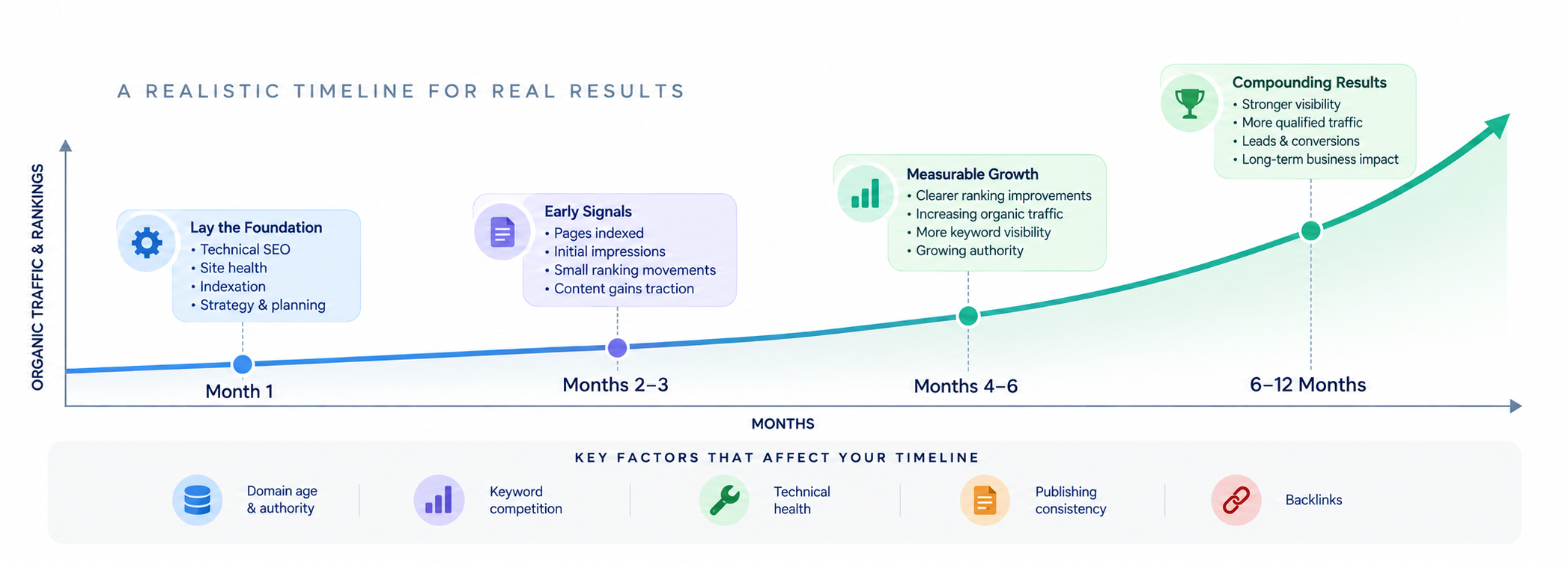
This is the shape most SEO engagements actually take, assuming consistent execution and no major technical blockers uncovered along the way.
Key insight: the first 30 days almost always look like nothing is happening, and that's exactly when the most consequential work gets done. Judging an SEO engagement's success in month one is like judging a construction project by whether the foundation looks like a finished building. It doesn't, and it isn't supposed to yet.
The three-to-six-month average hides enormous variance. These five factors explain most of it.
Local SEO is the one meaningful, consistently observed exception to the broader national timeline. Google Business Profile optimization can show movement within four to eight weeks, and local pack ranking improvements often land within two to four months, well ahead of the national organic timeline described above, because the competitive set is smaller and the ranking signals are more directly controllable. We break down the local-specific version of this in more depth in our local SEO basics guide.
Anyone asking when will SEO show results in 2026 is asking a slightly different question than they were two years ago, because a first-page ranking no longer guarantees a click the way it used to. The most methodologically rigorous study on this, a Pew Research Center analysis of nearly 69,000 real Google searches, found that users click a traditional organic result only 8% of the time when an AI Overview is present, compared to 15% when it isn't, a roughly 47% relative decline. Only 1% clicked a link inside the AI Overview itself, and roughly a quarter of these sessions ended without any click at all.
The practical shift for anyone planning a timeline: AI Overviews now appear on somewhere between roughly 25% and 50% of Google searches depending on the study and query type, with informational and research-heavy categories, health, home improvement, B2B technology, affected most heavily. Transactional and navigational searches, the ones closest to a purchase or a specific business, see meaningfully less AI Overview exposure, which is part of why local and service-business SEO has held up better than broad informational content strategies through this shift.
This doesn't mean SEO stopped working, and it's not a reason to abandon organic strategy altogether. It means the definition of "working" has to expand. Citation within an AI Overview, brand mentions without a click, and qualified visits from users who skip the summary to dig deeper all matter now in ways a pure rankings-and-traffic report misses entirely. A timeline conversation that only tracks position and sessions is measuring 2023's version of success against 2026's search landscape.
Before any SEO engagement starts, these are the questions worth answering explicitly, whether you're briefing an internal team or evaluating an agency.
The pattern holds consistently across the SEO engagements that go well: the first month feels slow because it is slow, deliberately. Weeks six through twelve bring the first genuinely encouraging signal, usually impressions climbing in Search Console before rankings move meaningfully, which is the leading indicator worth watching closely during this window rather than checking rankings daily and finding nothing. By month four to six, first-page positions for reasonably competitive terms start appearing, and traffic growth becomes visible enough to show up in a normal monthly report rather than requiring a magnifying glass.
The engagements that stall almost always share one trait: someone loses patience in the first ninety days, right before the compounding effect the entire strategy was built around actually kicks in. Understanding that arc in advance, and agreeing on it explicitly before work starts, is what separates a client relationship that survives the quiet months from one that doesn't. It's also why the timeline conversation belongs at the very start of an engagement, not three months in when someone is already frustrated and looking for a reason to cut the strategy short.
How long does SEO take to work? Three to six months for the first genuinely measurable results is the honest average, six to twelve for the kind of growth that changes a business, and local SEO can move faster than either. But the number matters less than knowing what you're actually measuring and why month one is supposed to look uneventful. An agency or strategist who can explain exactly what should be happening in weeks two, eight, and twenty, before you ask, is a far better signal of competence than one who just quotes the three-to-six-month average and moves on.
Want a timeline built around your actual site, competition, and goals instead of an industry average? Talk to an SEO strategist about your timeline and we'll map out realistically what to expect and when, based on where your site stands today, not a generic month-by-month template pulled off a blog post.