Most small business owners think local SEO means claiming a Google Business Profile and calling it done. That single step used to be enough to get noticed. It isn't anymore. Google now weighs dozens of signals before deciding which three businesses to show in the map pack for any given search, and a claimed-but-untouched profile competes against listings that are updated weekly with fresh photos, reviews, and posts.
This guide covers the local SEO basics that actually move the needle: what Google looks at when ranking local results, the specific steps that build each signal, and the mistakes that quietly keep otherwise good businesses out of the map pack. None of this requires a marketing degree. It requires knowing where to spend your time, which is exactly what most small business owners are never shown.
Local SEO is the practice of making your business easy for Google, and for nearby customers, to find, verify, and trust when someone searches for what you offer near a specific location. That's different from traditional SEO, which competes for rankings across an entire country or the whole internet. Local SEO competes within a radius, often just a few miles.
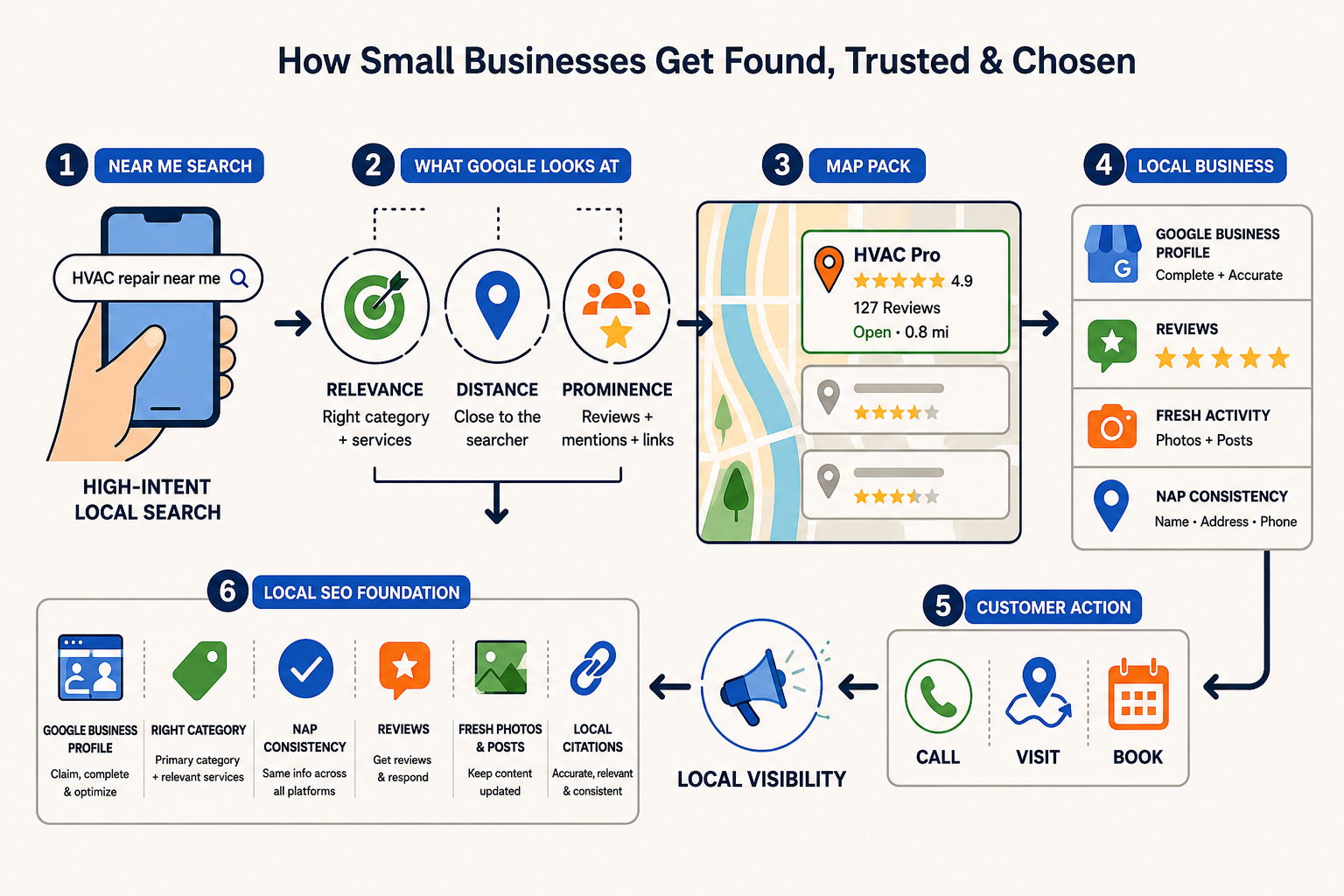
Google has been consistent about how it decides local rankings. According to Google's own Business Profile documentation, local results are based mainly on three factors: relevance, distance, and prominence. Relevance is how well your profile matches what someone searched for. Distance is how close you are to the searcher or the location implied in their query. Prominence is how well known and trusted your business appears to be, based on signals like reviews, mentions, and links from around the web.
You can't do much about distance. A customer three miles away will usually beat a better business ten miles away for a "near me" search, and no amount of optimization changes geography. Relevance and prominence, though, are almost entirely within your control, and that's where local SEO basics actually live, and where our Local Business Marketing services spend most of their time on a new account.
"Near me" search behavior has changed shape fast, and most small business owners are still operating on an outdated picture of how customers find them.
Search trend data from Google itself shows "near me" and "close by" search queries have grown roughly 900% over the past two years. Semrush's 2026 keyword data puts monthly search volume for "near me" keyword variations at 7.1 million in the U.S. alone, and industry tracking from BrightLocal finds that roughly 80% of U.S. consumers search for a local business online at least once a week, with close to a third searching daily.
The intent behind these searches is unusually strong. Multiple 2026 industry reports, including data compiled by BrightLocal and SOCi, put the share of "near me" mobile searches that lead to a business visit within 24 hours at around 76%. That's not window shopping. Someone searching "plumber near me" at 11pm has a burst pipe, not a research project.
Key insight: A near me search is one of the highest-intent moments in the entire buying journey, and most small businesses aren't set up to win it. Industry benchmarking from Digital Applied and similar sources estimates 58% of businesses still don't optimize for local search at all, and only around 30% have any kind of actual plan for it. That gap is the opportunity.
A few years ago, improving your near me search ranking mostly meant chasing a spot in the traditional map pack. That's still the biggest prize, but two shifts are changing what "showing up" even means.
First, voice search leans heavily local. Industry tracking from BrightLocal and SynUp puts the share of voice searches with local or "near me" intent at somewhere around three in four. Someone asking a smart speaker or their phone to find "a coffee shop near me" is being read the same structured data your Business Profile provides, which means an incomplete profile now costs you visibility across more surfaces than just a screen.
Second, AI Overviews and AI-powered search assistants are increasingly answering local queries directly, sometimes without the searcher ever clicking through to a traditional map pack. Recent industry reporting suggests AI Overviews now appear on a meaningful share of local searches, and that share has grown steadily through 2025 and into 2026. The businesses that show up in those AI-generated answers tend to be the ones with clean, consistent data and a strong presence across reviews and directories, the exact same signals that drive traditional local rankings. In other words, getting the fundamentals right isn't just insurance against Google's map pack changing. It's increasingly the same work that keeps you visible as AI search grows.
This is the order we walk new clients through, starting with the highest-leverage steps first.
| Step | What To Do | Why It Matters |
|---|---|---|
| 1 | Claim and fully verify your Google Business Profile | This is the primary data source Google uses to build local results; an unverified or incomplete profile is a weak match for any search |
| 2 | Choose an accurate, specific primary category | Category is one of the strongest relevance signals Google has; a narrower accurate category usually outranks a broad, vague one |
| 3 | Standardize your name, address, and phone number (NAP) everywhere it appears online | Inconsistent NAP across directories confuses Google's matching and is one of the most common causes of suppressed rankings |
| 4 | Add complete service and product listings with real descriptions | Gives Google structured data to match your listing against specific queries, not just your business name |
| 5 | Add your city and service area naturally to your website's homepage and service pages | Reinforces relevance for location-based queries beyond what your Business Profile alone can signal |
| 6 | Build listings on major local directories (industry-specific and general) | Each consistent citation reinforces prominence and helps verify your business is legitimate and active |
| 7 | Build an ongoing review generation habit, not a one-time push | Review volume and recency both feed prominence, and businesses in the top three local results average far more reviews than those ranking lower |
| 8 | Respond to every review, positive and negative | Signals an active, trustworthy business and often matters more to prospective customers than another five-star review |
| 9 | Post photos and updates on a regular cadence | Google treats recent activity as a freshness signal, and profiles with more photos consistently get more clicks and direction requests |
Notice what's missing from this list: nothing here requires paid ads, a redesigned website, or months of link building. That's the point. Local SEO basics are mostly about completeness and consistency, not creativity. If you want the deeper walkthrough of steps 1 through 3 specifically, we cover Google Business Profile setup in more detail in our Google Business Profile optimization checklist.
Business owners who've dabbled in general SEO sometimes assume local SEO is the same game played smaller. It isn't. The inputs that matter shift.
| Factor | Traditional SEO | Local SEO |
|---|---|---|
| Primary ranking surface | Organic search results (website pages) | Map pack and Google Business Profile, plus organic results |
| Competitive set | Every relevant website nationally or globally | Businesses within a few miles of the searcher |
| Strongest signal | Backlinks and content depth | Google Business Profile completeness and category accuracy |
| Trust signal | Domain authority, editorial mentions | Review volume, recency, and response rate |
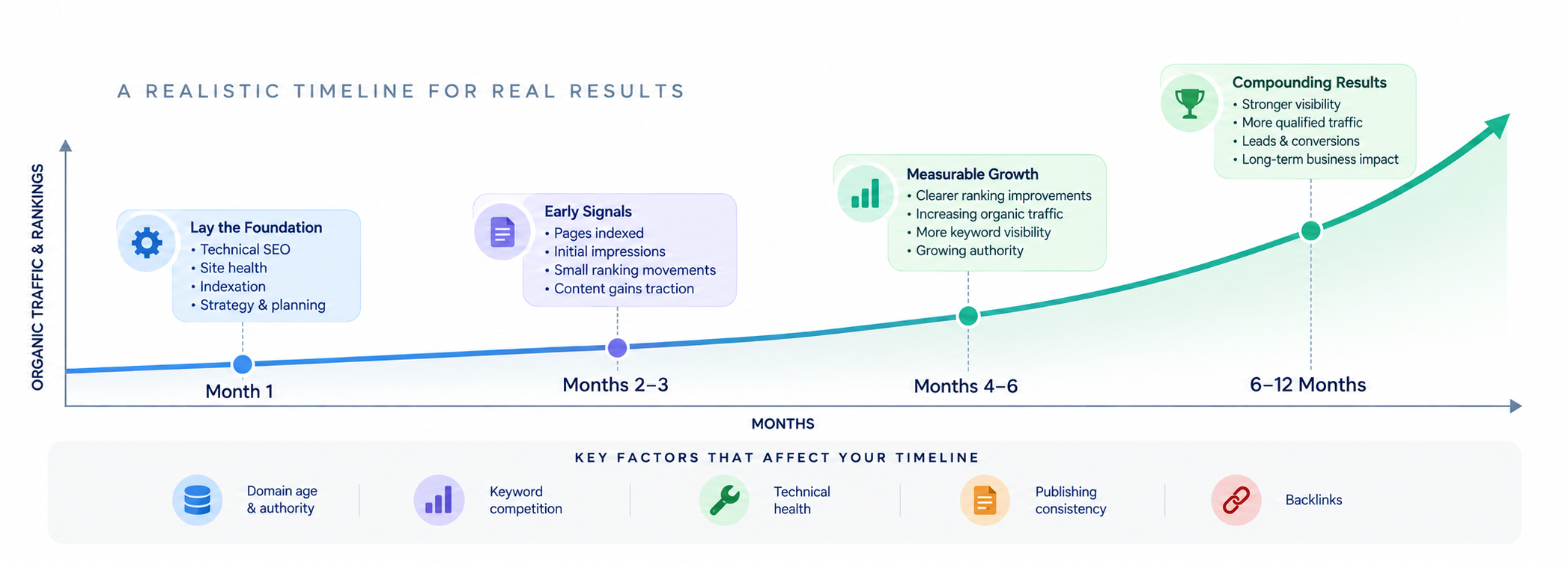
| Typical timeline to see movement | Several months to a year | Often 8 to 12 weeks for an actively managed profile |
That faster timeline is one of the most underrated things about local SEO basics. Because the map pack draws so heavily from your Google Business Profile rather than months of accumulated authority, a business that commits to the checklist above can often see real movement within a couple of months, not a year.
The pattern is remarkably consistent across established local businesses with weak visibility: a decent reputation, real longevity, and a Google Business Profile that was set up once and never touched again. One broad category instead of the specific services that actually pay the bills. A dozen photos from a single shoot years ago. No history of responding to reviews, positive or negative. None of that is a niche problem; it's the default state for a business that claimed its listing and considered local SEO finished.
The fix is rarely complicated, which is exactly why it gets skipped. Adding the specific secondary categories that match real service lines, rewriting the business description to name the actual service area instead of vague language, and starting a simple text-message review request after every completed job typically moves the needle faster than almost anything else on this checklist, because these are signals Google can verify immediately rather than signals that take months to accumulate. Photo cadence matters the same way: a business that goes from a static, years-old dozen to a rolling monthly upload of real, recent work is sending an activity signal that a technically perfect but frozen profile can't match.
None of this requires a new website or paid ads. It requires treating the profile as something to maintain weekly rather than a form filled out once. Timelines vary heavily by how much local competition exists in a given market, so results compound faster in a less contested category than a crowded one, but the sequence itself, category accuracy, then consistency, then reviews, holds regardless of market.
You don't need to tackle all nine steps in the checklist at once. If you're starting from zero, the order that moves the needle fastest is usually: verify your Google Business Profile, fix your primary category, standardize your NAP across the handful of directories that matter most for your industry, and start asking every satisfied customer for a review before you move on to anything else. Those four alone will put most small businesses ahead of the 58% of competitors who, according to recent industry benchmarking, aren't optimizing for local search at all.
If you want a simple way to think about sequencing beyond that first week, treat it as three phases rather than nine disconnected tasks. Phase one is data accuracy: your Business Profile, your website, and your directory listings all saying the exact same thing about who you are and where you are. Phase two is proof: reviews, photos, and posts that show Google and customers that the business is active and trusted right now, not just accurately described. Phase three is expansion: additional categories, additional directories, and location-specific content on your website once the fundamentals are solid. Most of the small business SEO tips you'll find online skip straight to phase three, which is exactly backwards. A business with a handful of well-chosen categories and a steady review cadence will consistently outrank one with dozens of directory listings and no review activity, because Google is weighing trust and activity more heavily than sheer volume of mentions.
It's also worth being honest about what local SEO can't do. No amount of local search optimization will overcome a business that's genuinely far from the searcher for a hyper-local query, and no checklist replaces an actual good customer experience, since reviews eventually reflect reality regardless of how well you ask for them. What these basics do is make sure a business that deserves to be found actually is, instead of losing visibility to a competitor who simply filled out their profile more completely.
Once the first four steps are done, put a recurring 15 minutes on the calendar. Each week: reply to every new review, upload two or three photos of recent work, and publish one short post about a job, an offer, or a seasonal service. Once a month, search your business name and confirm the phone number and address match on the top five results.
If visibility still lags after two months of that, check three things in order: whether your primary category is too broad, whether an old directory listing has a wrong phone number or address, and whether review requests quietly stopped going out.
Want a clear picture of exactly where your local search visibility stands? Get a free local SEO audit and we'll walk through your Google Business Profile, citations, and review strategy together, and show you the specific fixes worth prioritizing first.


.png)