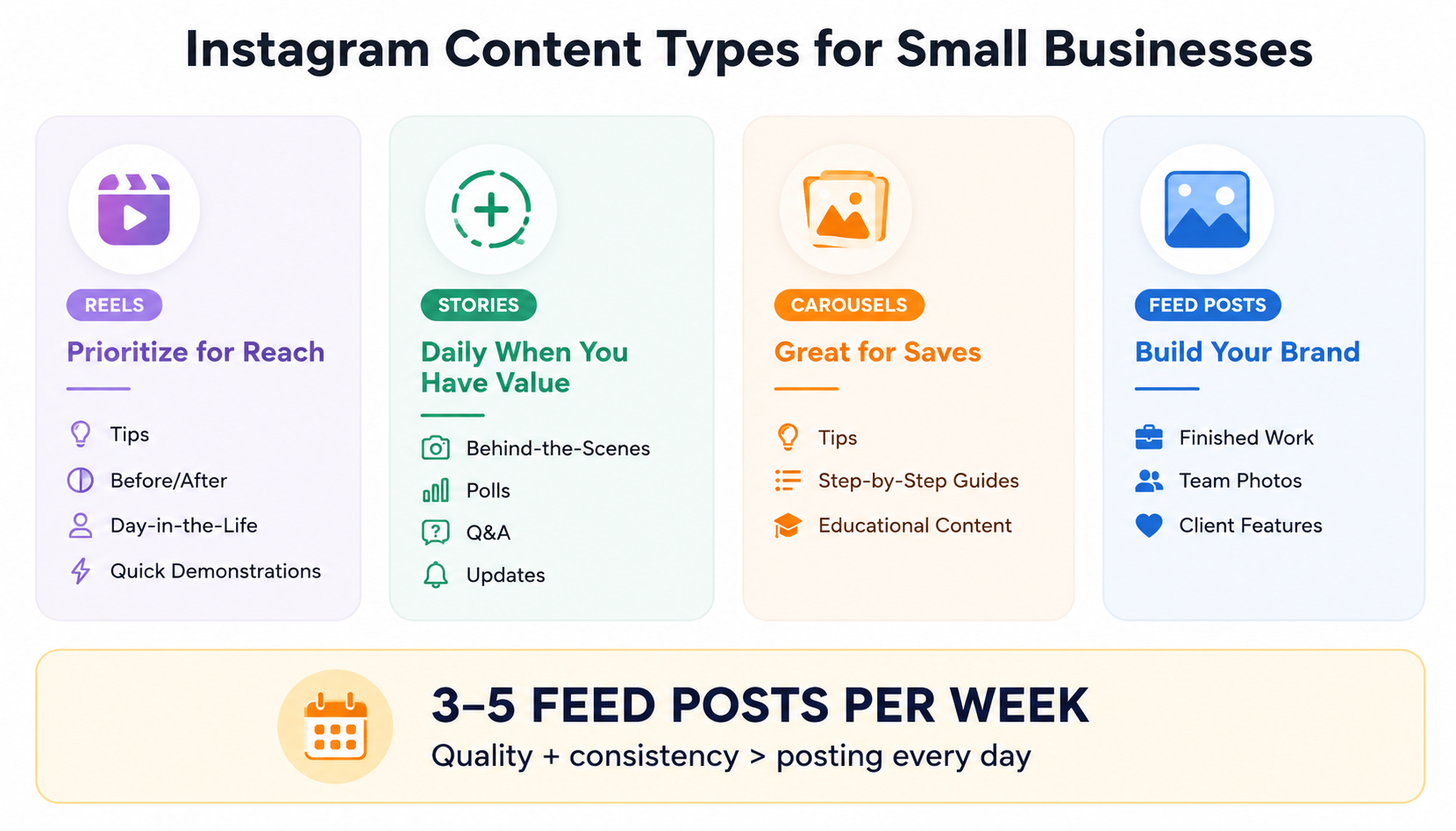
Small business owners ask us "how often should I post on Instagram?" more than almost any other social media question, and the honest answer disappoints most of them: posting daily is not the win it used to be, and for a lot of accounts it's actively wasting effort that would perform better spent elsewhere. Instagram's own leadership has said as much. Head of Instagram Adam Mosseri has confirmed the platform ranks content on watch time, likes per reach, and sends per reach, not on how many times an account shows up in a given week, a distinction that changes almost everything about how a small business should plan its content calendar.
This guide breaks down how often should a small business post on Instagram using what's actually driving reach in 2026, not the "post every day" advice that's been recycled since 2018. We'll cover what the data says, why the old daily-posting rule stopped working, a practical framework for setting your own cadence, and the mistakes that quietly cap engagement no matter how consistent you are.
The daily-posting rule came from an era when Instagram's feed was mostly chronological and reach was a function of how often you showed up in front of people who already followed you. That era is over. Instagram now runs separate ranking systems for Feed, Reels, Stories, and Explore, and each one weighs engagement quality far more heavily than raw volume.
Mosseri has been direct about this. In a widely cited January 2025 statement that still governs ranking behavior into 2026, he named watch time, likes per reach, and sends per reach as the three signals that matter most across surfaces, deliberately leaving follower count and posting frequency off that list. Sends, meaning content shared via DM, carry particular weight for reaching people who don't already follow you. Likes matter more for distribution to your existing audience. Posting frequency isn't part of either calculation directly.
Key insight: frequency still matters, but indirectly. Posting more often gives you more chances to earn watch time and sends, and it signals an active account. But a mediocre daily post earns none of the signals that actually drive reach, while a strong post shared twice a week can outperform it on every metric that counts. Chasing volume without chasing quality is the fastest way to burn out a small team while reach stays flat.
Strip away the platform-specific jargon and the research lines up more consistently than the endless "how often to post" debate suggests.
None of these numbers is "the" answer. They're a converging range, and the range matters more than any single figure inside it. If you're posting less than twice a week, moving up toward that range is the highest-leverage change you can make. If you're already posting five or more times weekly and engagement is flat, more volume isn't the lever to pull.
This is the sequence we walk clients through when they're rebuilding a stalled Instagram cadence. Start with capacity, not a number pulled from a blog post.
| Step | What to Do | Why It Matters |
|---|---|---|
| 1 | Set a cadence you can sustain for 90 days, not 90 hours | Instagram's ranking rewards a track record; sporadic bursts followed by silence perform worse than a lower, steady cadence |
| 2 | Start in the 3 to 5 feed posts per week range | Where most current research converges as the sustainable sweet spot for small business accounts |
| 3 | Layer in Stories daily if you have the content | Stories run on a separate, more forgiving ranking system and reward frequent, casual posting differently than feed content does |
| 4 | Prioritize watch time over polish for Reels | Watch time is the single most heavily weighted ranking signal across surfaces; a simple, complete Reel beats a highly produced one people scroll past |
| 5 | Check Insights every 2 weeks, not daily | Daily checking reacts to noise; a two-week window shows whether your cadence and content are actually trending in the right direction |
| 6 | Increase frequency only after quality holds steady | Adding volume before your content system can support it is the single most common way small businesses burn out their own account |
Notice that "post more" isn't step one anywhere in this sequence. It's the last lever, applied only once the earlier steps are working. Most small business owners have that order backwards.
A frequency target is only useful if it survives contact with an actual week. Most small businesses that abandon Instagram after a few months didn't fail because the platform stopped working. They failed because they built a social media posting schedule around an aspirational number instead of their real capacity, burned out within a month, and went quiet, which is the single worst outcome for an algorithm that rewards a track record.
A workable schedule starts with an honest inventory: how many hours per week can realistically go toward content, who's shooting it, who's writing captions, and who's actually posting. From there, block your cadence around content batching rather than daily creation. Shooting four Reels in one afternoon and scheduling them across two weeks produces more consistent quality than trying to conceive, shoot, and post something fresh every single day. Most scheduling tools, including Meta's own Business Suite, let you queue posts in advance specifically so cadence doesn't depend on someone remembering to post live every day.
The other half of a working schedule is reviewing your own Instagram engagement data on a fixed cycle, not an anxious one. Pull your top nine posts from the last 90 days in Instagram Insights every two weeks. Look specifically at watch time, saves, and sends, the three signals Instagram has confirmed matter most, rather than defaulting to likes or follower growth. If a format or posting day consistently underperforms across two or three review cycles, that's a real signal worth acting on. A single slow post is noise.
One reason "how often should I post" resists a single answer is that it's really three separate questions bundled into one, since each Instagram surface runs its own ranking system with different priorities. We break down platform-specific strategy in more depth in our piece on organic versus paid social, but the frequency-specific version looks like this.
| Format | Suggested Frequency | Primary Ranking Signal | Best For |
|---|---|---|---|
| Feed posts (photos, carousels) | 3 to 5 per week | Likes per reach, saves | Deeper storytelling, product detail, evergreen content |
| Reels | 2 to 4 per week | Watch time, sends per reach | Reaching people who don't already follow you |
| Stories | Daily, several per day | Completion rate, replies | Staying top-of-mind, behind-the-scenes, quick promotions |
The practical implication: a small business posting three well-made Reels a week alongside daily Stories is very likely outperforming a competitor posting one feed photo every single day. Volume alone was never the point. Volume in the right format was.
The pattern shows up often with small businesses that post daily out of obligation: quick phone photos, minimal captions, steady volume, flat engagement, and a team that's visibly tired of the pace. Daily posting has quietly turned into a chore instead of a strategy, and the sheer volume hides the fact that very little of it is earning the signals Instagram actually ranks on.
The fix usually isn't posting less for the sake of it. It's rebuilding the content around a few formats that match how the ranking systems work: a weekly Reel showing a real moment with real audio, a couple of feed carousels that teach something specific, and daily Stories for the quick, low-effort updates. Total feed volume often drops as a result, while reach tends to climb because Reels earn more watch time and DM shares than daily photo posts do. Carousel captions that teach something specific instead of just describing the image also tend to earn more saves, which Instagram reads as a sign the content is worth surfacing again later. The account does less in raw post count and gets more back, because the content finally matches what the platform is built to reward.
Pick a cadence you can hold for a full quarter, not the one that sounds most impressive. For most small businesses that means three to five feed posts a week, Stories whenever there's something worth showing, and Reels doing the heavy lifting on reach. Then judge it on saves, sends, and watch time instead of follower counts and likes, because those are the signals that decide whether Instagram shows your content to anyone new.
If engagement is flat, resist the urge to add another post to the week. Check first whether the posts you already publish earn any watch time or shares. More volume built on a format that isn't working just gives you more of the same result.
Not sure whether your current posting cadence is working for or against you? Request a free social media audit and we'll show you exactly where your Instagram strategy is leaving reach on the table.