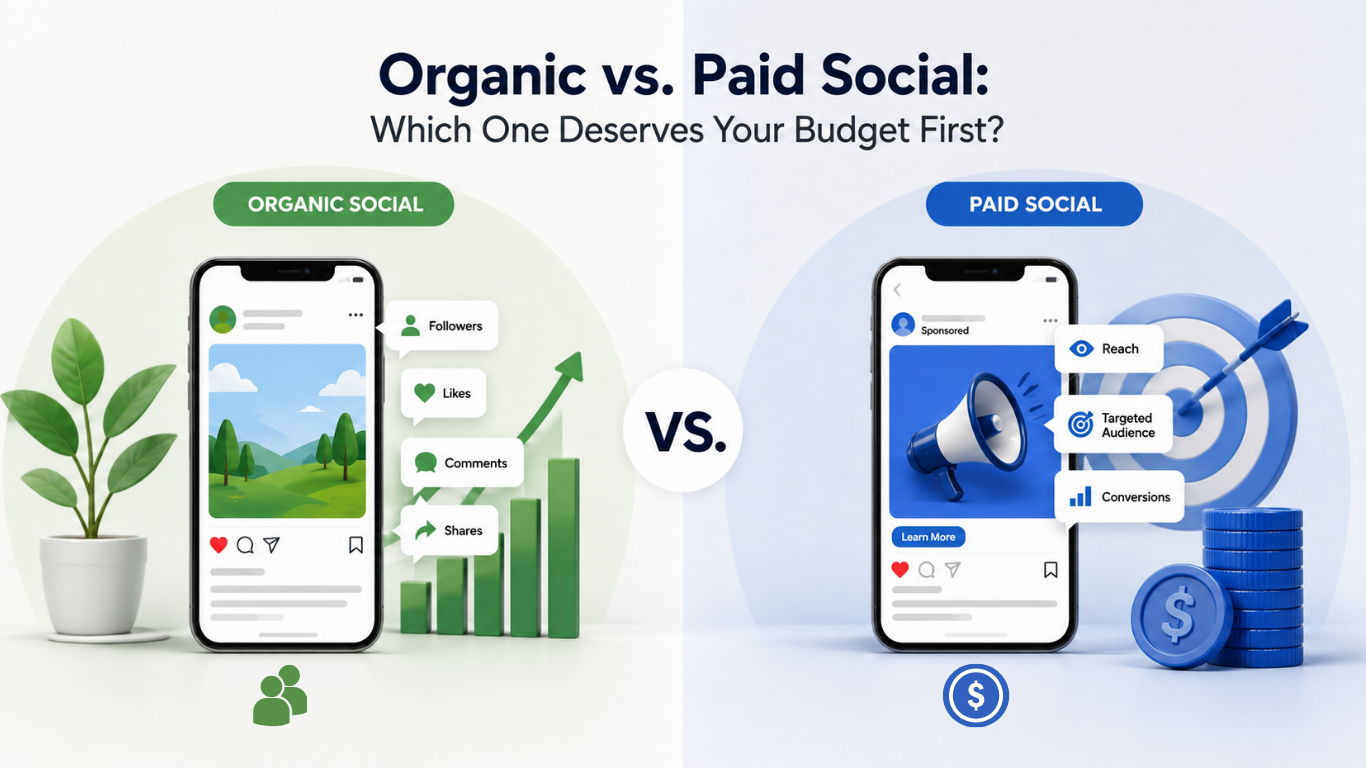
Every founder we sit down with asks some version of the same question: should the next marketing dollar go toward building an organic following or toward paid social ads? The honest answer is that organic vs paid social isn't really an either/or decision. It's a sequencing decision, and most small businesses get the sequence backwards. They either dump their entire budget into boosted posts before they have anything worth boosting, or they spend a year "building community" with no paid amplification and wonder why growth has stalled. Neither approach is wrong forever. Both are wrong at the wrong stage. This article breaks down exactly how to think about social media budget allocation so you're not guessing.
Organic social and paid social aren't competing philosophies. They're two different jobs, and confusing them is where most budgets go to die.
Organic social is proof. It's the unpaid content you publish that shows up in followers' feeds based on relevance and engagement signals. Its job is to demonstrate, over time, that you understand your audience well enough to earn their attention without paying for it. That's a credibility signal, and credibility compounds, but it compounds slowly.
Paid social is distribution. It's money you spend to guarantee placement in front of a specific audience, regardless of whether the algorithm would have shown them your content otherwise. Its job is speed and control. You're not waiting to earn reach; you're buying it.
The mistake we see constantly is businesses treating these as substitutes rather than as sequential tools. A paid social strategy built on top of thin, unproven organic content is really just an expensive way to find out your offer or creative doesn't resonate. And organic social growth pursued in isolation, with no paid support, means your best-performing content (the post that actually converts) never reaches anyone beyond the people who already follow you.
Key insight: Paid social doesn't replace organic content. It amplifies whatever organic has already proven works. If you haven't proven anything yet, you don't have anything worth amplifying.
Five years ago, this was a lower-stakes decision because organic reach, while declining, still delivered meaningful visibility on its own. That's no longer true, and the shift changes the math for small business budgets specifically.
Organic reach has been in a multi-year decline across every major platform as algorithms increasingly prioritize content that drives conversation over content simply published by accounts people follow. Sprout Social's 2025 Content Benchmarks Report found that brands saw a 20% year-over-year jump in average inbound engagements, which suggests audiences are still active on social platforms but have become far more selective about what earns their attention. Hootsuite's own analysis of organic reach trends puts the scale of the drop in stark terms: Facebook's average organic reach, which stood at 16% in 2012, had fallen to somewhere between 1% and 2% by 2025, with Instagram down roughly 12% year over year and LinkedIn seeing an even steeper decline of around 34%.
At the same time, paid media isn't getting cheaper. Gartner's 2025 CMO Spend Survey found that paid media now commands close to a third of total marketing budgets (about 30.6%), an 11% year-over-year increase in share of company revenue, as CMOs lean on paid channels for the targetability and adaptability that organic can't reliably deliver in a volatile market. Translation: everyone else is also shifting budget toward paid, which puts upward pressure on your costs too.
Here's the part that matters most for a small business owner reading this with a finite monthly budget: neither channel is inherently "better." Reach itself is scarce and getting scarcer on the organic side, and expensive and getting more expensive on the paid side. That's exactly why when you deploy each dollar, not just whether you spend it, is the actual strategic question, and it's the first thing we map out in every social media strategy engagement we take on.
We think about this in three stages. Almost every small business we've worked with fits cleanly into one of them, and the right allocation looks different at each.
At this stage, you don't yet know what your audience responds to. You haven't built a library of content that's been tested against a real audience. Spending heavily on paid social here means you're paying to distribute guesses.
The priority is organic, not because it's free (it isn't free; it costs time) but because it's how you generate the data you'll need before paid spend can be efficient. A modest amount of paid budget belongs here too, but its job isn't scale. It's testing: small-budget A/B creative tests to see what a cold audience responds to, run at a level where a wrong answer doesn't hurt.
This is the stage most small businesses get stuck in longest, and it's usually because they keep pouring resources into organic content that's already proven itself, expecting the algorithm to eventually reward volume. It won't. You've already extracted what the algorithm is willing to give that content for free.
This is exactly when paid social earns its budget. Not new creative concepts. The content you already know converts, put in front of audiences who haven't seen it yet. This is where paid social strategy starts to outperform organic dollar-for-dollar, because you're de-risking spend with data instead of guessing.
Here the relationship inverts again, but not back to organic-first. At scale, paid becomes the primary growth engine and organic becomes the trust layer that makes paid perform better: cold audiences check your feed before they buy, and thin, inconsistent organic presence undercuts paid conversion rates even when the ad itself is strong.
| Brand Stage | Primary Budget Focus | Organic Role | Paid Role | Typical Split |
|---|---|---|---|---|
| Pre-Proof | Organic content development | Core activity — build audience insight | Small-budget creative testing only | 80% organic / 20% paid |
| Proof, No Scale | Amplifying what's already working | Continue publishing, mine for winners | Boost proven content to new audiences | 40% organic / 60% paid |
| Scale | Paid acquisition | Trust-building, supports paid conversion | Primary growth driver | 20–25% organic / 75–80% paid |
This isn't a rigid formula. A service business selling a $15,000 engagement will weight differently than a $30 ecommerce product, but the directional logic holds across nearly every small business we've advised, the same logic we use to build out a stage-appropriate budget plan for new clients.
Before you set next quarter's split, run through this. If you can't answer "yes" to most of these for organic, don't fund paid yet, you'll just be paying to distribute untested content.
| Question | If Yes | If No |
|---|---|---|
| Do you have at least 90 days of consistent organic posting? | Move to evaluating conversion data | Focus budget on organic content cadence first |
| Can you name your 3 best-performing organic posts and why they worked? | You have creative worth paying to amplify | Keep testing organically before spending on distribution |
| Do you have a working conversion path (landing page, DM flow, booking link) tied to social? | Paid spend has somewhere to send traffic | Fix the conversion path before buying reach |
| Has your organic growth plateaued despite consistent output? | Paid is likely your next lever | Organic still has room to run — don't rush to paid |
| Do you have at least 3 months of budget runway for paid testing? | You can absorb a learning curve | Wait, or start with a smaller organic-first test |
Mistake 1: Boosting posts instead of building campaigns. Hitting the "boost" button on a random post isn't a paid social strategy. It's spending money without a targeting logic, a funnel, or a measurement plan. We've seen businesses burn through months of ad budget this way with no way to say what, if anything, it produced.
Mistake 2: Treating organic and paid as separate teams with separate goals. If the person running your organic content has no visibility into which posts are being amplified with paid budget, or why, you lose the feedback loop that makes the whole system work. The two need to report to the same strategy, even if different people execute them.
Mistake 3: Panicking and cutting organic entirely once paid starts working. This is the fastest way to see paid performance quietly erode over two or three quarters. Cold audiences use your organic feed as a trust check before converting. A feed that's gone dark, or one that's clearly become an ad-only channel, depresses paid conversion rates even when targeting and creative haven't changed.
Consider a home services business (this comes up constantly in our work) that's been posting inconsistently on Instagram for a year with a few hundred followers and no ad spend. The instinct is usually to jump straight to paid: "we need more leads, so let's run ads." What typically happens is a few hundred dollars go toward boosting whatever was posted most recently, cost-per-lead comes back ugly, and the owner concludes "social ads don't work for us."
The actual problem wasn't the paid channel. It's that there was no organic signal to amplify: no proof of what messaging, offer, or format this specific audience responded to. The fix isn't abandoning paid. It's spending 60 to 90 days publishing consistently, watching which posts (a before/after job, a pricing-transparency post, a quick FAQ video) actually generate saves, shares, or DMs, and then putting paid dollars behind that specific content and message. The industry-wide reality that Instagram ad CPMs for feed placements averaged $7 to $12, with Reels ad placements averaging closer to $4.29 in 2025, makes this sequencing even more important. Every dollar spent amplifying an unproven message is a dollar spent at that CPM with no evidence it'll convert.
It helps to know where you sit relative to peers. Recent analysis of small business marketing spend found that the average local business puts somewhere between 5% and 10% of revenue toward digital marketing overall, with businesses spending roughly 14.9% of that marketing budget specifically on social media. That's a useful benchmark, but it's a starting point, not a target. The stage-based split above matters more than hitting an industry-average percentage.
It's also worth noting that budget intent is trending upward, not down: nearly half of small businesses, 49%, said they planned to increase marketing budgets, while only 16% planned to decrease them. If you're planning growth for next year, the businesses you're competing with for attention are very likely planning the same thing, which is one more reason a reactive, boost-whatever's-newest approach won't hold up.
| Feature | Organic Social | Paid Social |
|---|---|---|
| Speed to results | Slow — builds over months | Fast — results within days |
| Cost structure | Time-intensive, low cash cost | Cash-intensive, scales with spend |
| Audience reach | Limited to followers + algorithm favor | Extends to precisely targeted new audiences |
| Best for | Testing messaging, building trust | Scaling what's already proven to work |
| Risk if done alone | Growth plateaus without amplification | Wastes budget on unproven creative |
| Long-term value | Compounds — becomes brand equity | Stops the moment spend stops |
Open your Instagram or Facebook insights and pull the last 90 days. Write down your three best posts by saves, shares, and DMs, and one sentence on why each worked.
If you can't fill in that list, you're pre-proof. Keep roughly 80% of your effort on organic and spend the rest on small creative tests. If you can fill it in and follower growth has gone flat, put a modest budget behind those three posts for two weeks, aimed at people who don't follow you yet. Track cost per lead or per DM, and only scale the one that holds up.
Ready to figure out exactly where your next social media dollar should go? Request a free social media budget strategy session, and we'll map out a stage-appropriate organic and paid allocation specific to your business, not a generic percentage split.