Most performance marketers troubleshoot a rising cost per lead by rebuilding the targeting: new audiences, new exclusions, another bid strategy test. That's usually the wrong lever. Independent research on ad effectiveness has repeatedly found that creative quality, not targeting or media spend, drives roughly half of a campaign's sales impact, and Meta's own automation has only made that gap wider. If your CPL is climbing and your creative rotation hasn't changed in six weeks, the fix isn't a smarter audience. It's a Meta ad creative lower CPL habit you haven't built yet.
We've audited enough Meta ad accounts to know the pattern: teams that treat creative as a monthly production task, rather than a weekly discipline, are the ones paying the most per lead. This piece breaks down the specific creative habits that consistently move CPL in the right direction, the framework we use to build them into a team's workflow, and the mistakes that quietly undo all of it.
A widely cited meta-analysis by NC Solutions, covering roughly 450 CPG advertising campaigns, found that creative quality accounts for about 49% of a campaign's contribution to incremental sales, more than double the combined contribution of targeting, reach, and recency, which together account for roughly 30% (NCSolutions creative effectiveness analysis, via MarketingCharts). Brand factors make up the rest. That ratio has held steady across multiple waves of the research, even as media buying has become more automated.
Meta's delivery system reinforces this rather than working around it. Advantage+ campaigns and broad targeting have pushed most of the algorithmic decision-making out of the advertiser's hands. What's left largely in the advertiser's control is the creative itself: the hook, the format, the offer clarity, and how quickly a new variant gets tested against the incumbent. When two advertisers are bidding into the same auction with similar audiences and budgets, the one with better-performing creative wins the impression at a lower cost, because Meta's ad auction explicitly rewards predicted engagement and conversion likelihood, not just bid amount.
Cost per lead on Meta has been rising industry-wide, not just for accounts with weak creative. WordStream's 2025 Facebook Ads benchmarks report, based on a sample of over 700 US lead-generation campaigns, found a median CPL of $27.66, up 20.94% year over year, though still well below the $70.11 median CPL the same report found for Google Ads lead campaigns (WordStream, 2025 Facebook Ads Benchmarks). Rising CPL industry-wide means the accounts holding CPL flat, or bringing it down, are doing something structurally different in their creative process, not just getting lucky with a cheaper quarter.
Attention is also getting harder to win on Meta's core surfaces specifically. eMarketer's 2026 platform analysis found that Instagram's average engagement rate for brand accounts fell from 16.9% in early 2024 to 9.7% by the end of 2025, even as competing short-form platforms grew (eMarketer, "Social media growth and engagement are concentrating on fewer platforms," 2026). Fewer organic impressions translate directly into more expensive paid ones once a feed gets more competitive and users scroll faster. Creative that doesn't earn attention in the first moment doesn't get a second chance at a reasonable price.
Key insight: CPL is a downstream metric. By the time it's rising, the actual problem, usually a stale hook, a mismatched format, or an unclear offer, has already been live and losing money for days.
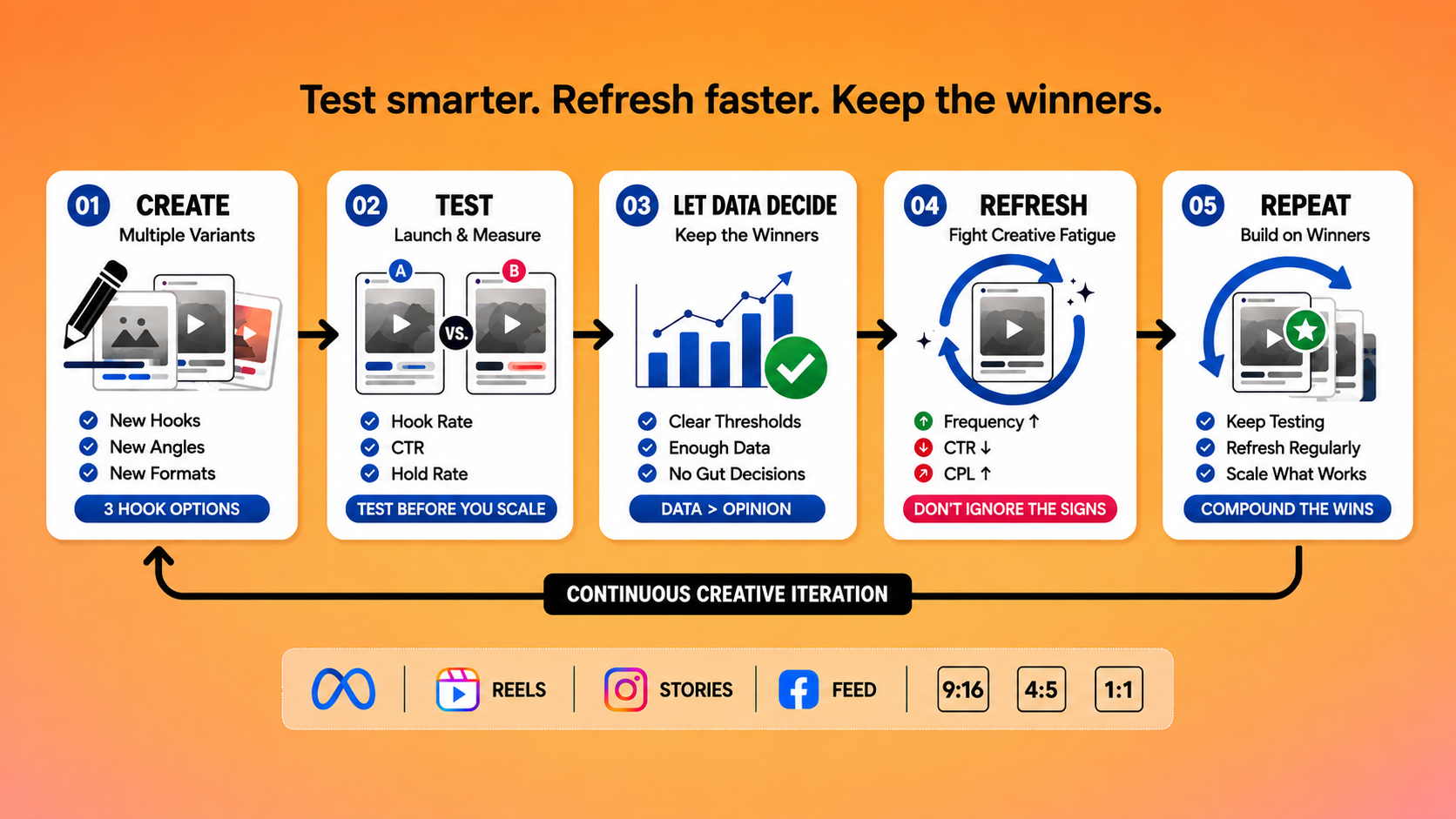
Most "Facebook ad creative best practices" content reads like a one-time checklist: use vertical video, add captions, keep it under 15 seconds. Those are correct but incomplete. The advertisers actually holding CPL down treat creative production as a recurring operating rhythm, not a project that gets revisited when performance drops. Below is the habit framework we build into client accounts.
| Habit | What It Looks Like in Practice | Why It Lowers CPL |
|---|---|---|
| Hook in the first 2 seconds | Lead with the outcome or the objection, not a logo or brand intro | Meta's delivery algorithm weights early engagement signals; a weak hook suppresses reach before the offer is ever seen |
| Design for sound-off, confirm for sound-on | Burned-in captions and visual storytelling that works muted, refined with audio for the sound-on segment | Most Instagram and Facebook feed views start muted; a message that depends on audio loses the majority of viewers instantly |
| Rotate before fatigue, not after | New creative variant introduced when frequency approaches 3 to 4 within the primary audience, not when CPL has already climbed | Waiting for the CPL spike means you've already paid the fatigue tax for days or weeks |
| Match format to placement | Native aspect ratios and pacing per surface (Reels, Stories, feed) rather than one asset resized everywhere | Placement-mismatched creative gets a lower relevance score and a higher effective CPM in that placement |
| Let data pick the winner, not the room | Structured creative testing with a clear primary metric, run to statistical stability before killing a variant | Subjective creative opinions inside a team are a common source of premature kills on variants that would have outperformed |
Meta's own creative guidance has consistently emphasized that the opening frame determines whether a video ad gets watched at all, and this holds whether the objective is leads or purchases. A logo intro, slow zoom, or generic stock-footage open is functionally a tax on your budget: it burns impressions before the offer is even visible. The strongest-performing hooks we see either state the specific problem the audience already has, or open mid-action, so the viewer has to watch another second to understand what they're looking at.
This is also where Instagram ad creative tips diverge slightly from Facebook feed norms. Reels and Stories reward a faster cut and a more native, less "produced" visual style; a feed placement can sustain a slightly slower build. Treating both placements identically is one of the more common ways teams quietly overpay for impressions that were never going to convert, and it's one of the first things we check in a Meta Ads creative audit.
Meta has reported for years that a majority of video views on Facebook and Instagram happen with sound off by default, particularly on mobile. Creative that relies on a voiceover or dialogue to convey the offer is invisible to most of the audience for the first several seconds. The habit that fixes this is straightforward: write the core message as on-screen text or burned-in captions first, then treat the audio track as an enhancement for the segment of the audience that does have sound on, rather than the primary delivery mechanism.
Creative fatigue is measurable before it shows up in CPL. Frequency climbing past roughly 3 to 4 within your core audience, alongside a flattening or declining CTR on an otherwise-stable audience, is the earlier and more actionable signal. Teams that only refresh creative once CPL has visibly worsened are always operating a few days behind the actual decay curve, and those days are expensive at scale.
| Signal to Watch | Healthy Range | Action Trigger |
|---|---|---|
| Frequency (7-day) | Below 3.0 | Approaching 3.5 to 4.0: queue a creative refresh |
| CTR trend (rolling 3-day vs. prior 3-day) | Flat or improving | Declining more than roughly 15 to 20% with stable audience: rotate |
| CPM trend on stable audience | Gradual, expected seasonal movement | Sharp upward move with no bid or budget change: check creative fatigue first |
Dynamic creative and Advantage+ placements have made it tempting to upload a single asset and let Meta distribute it everywhere. The delivery system will do that, but a 1:1 static image running in a 9:16 Reels placement, cropped and stretched, is not a fair test of whether Reels works for your offer. Building at minimum a vertical, sound-off-first video for Reels and Stories, alongside a separate feed-optimized asset, consistently outperforms the one-size-fits-all approach once you account for the difference in effective CPM by placement.
Structured testing sounds obvious, but the actual discipline is resisting the urge to kill a new variant after 48 hours because it "feels" like it's underperforming a favorite. Meta's delivery system needs enough events to exit the learning phase and stabilize CPL estimates. Cutting a test early, based on a gut read rather than a predefined sample size or spend threshold, is one of the most common ways teams throw away a creative that would have eventually won.
We see the same handful of creative mistakes across otherwise well-run accounts.
| Mistake | Why It Happens | The Fix |
|---|---|---|
| Reusing one asset across every placement | Feels efficient; dynamic creative tools make it easy to skip format-specific builds | Build placement-native versions for Reels/Stories vs. feed, even if the core message stays the same |
| Judging creative on day-two performance | Impatience, or pressure to report a result quickly | Set a minimum spend or event threshold per variant before evaluating |
| No consistent testing cadence | Creative production is treated as ad hoc, not scheduled | Put a weekly or biweekly creative refresh on the calendar regardless of current performance |
| Optimizing copy, ignoring the hook | Copy feels easier to iterate than video or the first frame | Treat the first 2 seconds of any video, or the first visual element of any static, as its own testable variable |
| No clear single offer per ad | Trying to communicate multiple value props at once | Isolate one offer or angle per creative and let performance data tell you which angle wins |
A quick gut check: if you can't name which specific creative variant is currently carrying most of your lead volume, your testing cadence isn't tight enough to catch fatigue before it costs you, a gap our creative testing playbook is built to close.
A performance marketer running lead generation for a mid-market B2B SaaS client sees CPL climb 35% over three weeks. The instinctive response is to rebuild the audience: tighten the lookalike, add exclusions, test a new interest stack. None of it moves the number.
The actual cause, once the account gets pulled apart, is almost always visible in the creative data: the top-spending ad has been live for five weeks without a variant refresh, frequency in the core audience has crossed 4.2, and CTR on that ad has dropped by nearly a third over the same window while CPM has climbed. The targeting was never the problem. The creative had fatigued, Meta's delivery system was compensating by paying more to reach the same shrinking pool of unconverted users, and every dollar spent tightening the audience further was making a shrinking, fatigued pool even smaller.
The fix is almost anticlimactic: two new creative variants built specifically for the placements carrying the most spend, launched alongside (not replacing) the original while it's still delivering, evaluated against a clear CTR and CPL threshold after a defined spend minimum. CPL typically recovers within the first week of the refresh, not because the audience got smarter, but because the auction stopped penalizing an ad the algorithm had already deprioritized.
CPL itself is a lagging indicator. The metrics that tell you whether your creative habits are functioning before CPL moves are:
Tracking these consistently is what separates teams that catch fatigue at day 10 from teams that catch it at day 25, after paying an inflated CPL for two extra weeks.
Block one recurring hour a week for creative, separate from your regular account check. In that hour, sort your active ads by 7-day frequency and by hook rate. Any ad above 3.5 frequency, or live longer than four weeks, gets a new variant queued that day.
Launch the variant alongside the original instead of replacing it, and write down the spend threshold you'll wait for before judging it. Do this for a month and you'll catch fatigue while it's still a frequency number, well before it shows up in your cost per lead.
If your CPL has been climbing and your team can't remember the last time a creative variant was actually rotated on schedule, that's usually diagnosable in an afternoon. Request a free Meta Ads creative audit and we'll walk through your current account, flag where fatigue or format mismatch is quietly inflating your cost per lead, and outline the specific creative habits that would move the number.


.png)