Most marketing teams treat reviews as a reputation problem to manage, not a research asset to mine. That's backwards, and it's an expensive mistake to keep making quarter after quarter. Your customers are writing detailed, unsolicited, brutally honest feedback about what's working and what isn't, in their own language, at scale, for free, and most of it sits unread in a Google Business Profile or a product page until someone needs a testimonial for a landing page. AI customer review analysis turns that pile of scattered feedback into something a marketing team can actually use: content ideas, campaign angles, and the exact language your customers use to describe why they bought from you.
This isn't about slapping a sentiment score on your reviews and calling it insight. It's a framework for extracting specific, usable marketing intelligence from feedback you're probably already collecting, and the mistakes that turn a genuinely powerful tool into a dashboard nobody looks at twice, month after month.
The scale of the opportunity is easy to underestimate. Businesses collectively generate more than 1.5 billion online reviews annually across major platforms, which has made manual analysis genuinely impossible for any business with meaningful review volume. A marketing manager skimming the last twenty reviews before a monthly report isn't doing analysis. They're sampling, and sampling misses the patterns that only show up clearly across hundreds of data points.
The stakes for getting this right keep climbing. According to 2026 research from BrightLocal, 93% of consumers read reviews before making a purchase decision, and 97% read reviews before choosing a local business specifically, with the average consumer now checking six different review sites before deciding. Nadernejad Media's 2026 analysis found Google reviews alone influence 91% of local purchase decisions. Reviews aren't peripheral to your marketing anymore. For a lot of businesses, they're doing more of the actual selling than the website.
Key insight: the language your customers use in reviews is closer to how your actual buyers talk about your business than almost anything your internal team could write from scratch. That's the real value of AI review sentiment analysis, not the sentiment score itself, but the raw language underneath it.
Most teams that dabble in review analysis stop at overall sentiment: a single positive, negative, or neutral score per review. That's a start, but it's not where the marketing value lives.
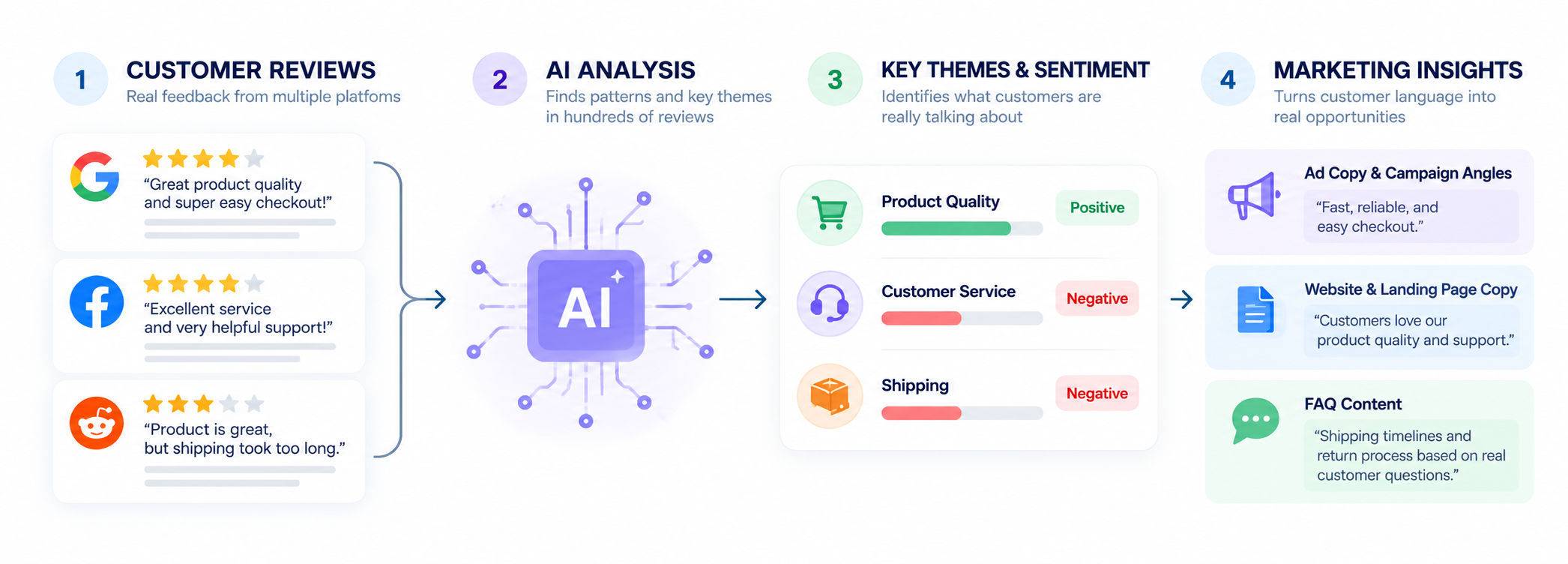
Aspect-based sentiment analysis, sometimes abbreviated ABSA, identifies specific attributes mentioned in a review and scores each one independently. A restaurant review saying "the food was amazing but the service was terrible" gets flattened into a mixed, unhelpful score under overall sentiment. Aspect-based analysis correctly separates it: strongly positive on food quality, strongly negative on service. That distinction is the difference between a report that says "sentiment is mixed" and one that tells your marketing team exactly which product attribute to feature and which operational issue to fix before featuring anything else.
For marketing purposes specifically, aspect-based analysis is what turns reviews into usable content. A vague "customers love us" sentiment score gives you nothing to write about. "Customers specifically praise the checkout speed and the packaging, and specifically complain about shipping timelines" gives you a testimonial angle, a UGC prompt, and a heads-up on what not to promise in your next campaign.
This is the process we use to move from raw review data to campaign-ready output, and it works whether you're running it through a dedicated review analysis tool or building a lighter version with a general AI assistant.
Step five is the one most teams skip, and it's the reason so many sentiment dashboards go unused after the first month, gathering the occasional glance during a quarterly review before fading back into the background. Analysis that stays inside the marketing team's inbox alone never closes the loop with the people who could actually fix what customers are complaining about.
You don't need enterprise software to start. Dedicated review analysis platforms exist for a reason, purpose-built aspect-based scoring, multilingual support, and direct integrations with review platforms save real time once volume gets high enough to justify the cost. But a business just starting to mine its reviews for marketing insight can get meaningfully useful output from a general AI assistant fed a clean export of review text, with a clear prompt asking it to identify recurring themes, pull verbatim praise and criticism by topic, and flag the most-repeated phrases.
The dividing line is volume and frequency, not sophistication. A business with a few hundred reviews reviewed quarterly can run this manually with an AI assistant and get real value. A business generating thousands of reviews monthly across multiple platforms needs something that ingests and updates automatically, or the analysis is stale before anyone acts on it. Starting manual and upgrading once the volume justifies it is a more sensible sequence than buying enterprise software before you've proven the exercise is worth doing at all.
Turning reviews into marketing content isn't limited to pulling a five-star quote for a testimonial slider, even though that's usually where teams stop. Once you've clustered themes and pulled verbatim language, the output maps to several concrete content formats.
Key insight: the goal isn't finding your best reviews. It's finding your most repeated reviews, the phrases and themes that show up independently across dozens of different customers, because that repetition is the actual signal. One glowing review is an anecdote. Twenty reviews independently praising the same specific thing is a positioning strategy you haven't fully claimed yet, and probably haven't even noticed sitting in plain sight.
Customer feedback insights pulled from review analysis rarely stay useful to marketing alone, and treating the exercise as marketing-only is how half its value gets left on the table. Aspect-based sentiment naturally sorts feedback into lanes: product complaints belong with product, service complaints belong with operations, and only the content-ready praise and positioning language belongs with marketing.
This matters because a one-star increase in average rating has been linked to measurable revenue growth, in the range of 5% to 9% according to recent research, which means the product and operations fixes surfaced by this same analysis are frequently worth more than the content ideas marketing pulls from it. Running the analysis as a marketing-only exercise captures a fraction of its actual value. Running it as a shared input across product, ops, and marketing, with a clear owner for routing findings to the right team, is what makes the investment pay for itself.
The pattern shows up consistently across review-rich businesses once they actually run this analysis for the first time: a specific attribute that's mentioned constantly in reviews and barely mentioned anywhere in the business's own marketing. A home services company might discover that "showed up exactly when they said they would" appears in a disproportionate share of their positive reviews, while their website talks almost entirely about pricing and service range. An ecommerce brand might find that packaging quality gets praised nearly as often as the product itself, an angle their product pages never touch.
The fix in both cases is the same: the underused attribute becomes the next campaign's headline, not a footnote. Businesses that make this shift typically see stronger ad performance quickly, not because the new copy is more creative, but because it's finally saying the thing customers were already saying, back to them, in language they recognize as true rather than as marketing. That recognition is worth more than clever copywriting, because it shortens the distance between an ad and a decision a prospect was already leaning toward making.
AI customer review analysis isn't valuable because it produces a sentiment percentage for a slide deck. It's valuable because your customers have already written your best marketing copy, buried across hundreds of reviews you're not reading closely enough to find it. The businesses getting real value from this aren't the ones running the fanciest sentiment tool. They're the ones actually routing what they find, back into ad copy, into product fixes, into the specific attribute they've been underselling, instead of generating a report and moving on to the next task.
If you're sitting on hundreds or thousands of reviews and have never systematically mined them for marketing language, that's not a data problem. It's an unused asset, and it's usually one of the fastest wins available in an account, precisely because the raw material is already sitting there, unpaid for and untapped, waiting for someone to actually read it at scale.
Ready to find out what your customers are already telling you? Schedule a customer insights consultation and we'll show you exactly what your reviews reveal about how to position, market, and improve your business.


.png)