Ask "can AI write ad copy that converts?" and you'll get two camps: one insisting AI-generated lines are indistinguishable from a senior copywriter's best work, the other insisting they're generic filler that tanks performance the moment real budget hits them. Both camps are arguing the wrong question. The most rigorous field research on this to date, a January 2026 study from researchers at Columbia, Harvard, the Technical University of Munich, and Carnegie Mellon, analyzed over 500 million ad impressions on Taboola's Realize platform and found something neither side expected: AI-generated ads matched or slightly outperformed human-made ones on raw click-through rate. But the win wasn't really about AI. It was about which ads didn't look like AI.
That distinction is the entire article. AI ad copy that converts isn't a tool question, it's a testing and judgment question, and most marketers evaluating AI creative tools right now are asking the wrong thing entirely.
This debate isn't theoretical anymore because adoption has already outpaced the evidence most teams are using to guide it. Survey data compiled in 2026 shows 90% of content marketers now plan to use AI in their marketing work, a rise of roughly 65% since 2023. Separate research from Statista found 81% of marketing professionals say AI has improved their writing productivity, and this is happening inside ad accounts, not just blog calendars, as Google and Meta push generative tools directly into campaign setup.
The same research surfaces the tension that makes this worth a real testing process instead of a policy decision made once and left alone: 47% of marketers say AI-generated text still sometimes lacks depth or originality, even as adoption climbs. Both things are true at once. Teams are shipping more AI-assisted copy than ever, and a meaningful share of that copy still reads as thin without human editing. That gap between adoption speed and output quality is exactly why AI vs. human ad copy performance needs to be measured account by account rather than assumed from a headline stat, yours or anyone else's.
Start with the headline numbers, because they're more interesting than either side of the debate wants to admit. In the Taboola-backed study, AI-generated ads recorded an average click-through rate of 0.76%, against 0.65% for human-made ads. The gap narrowed under tighter statistical controls but stayed directionally consistent across the full dataset of three million clicks.
Here's the part that gets buried in most summaries of this research: AI-generated ads that didn't look like AI achieved the highest engagement of any group in the study, beating both human-made ads and AI ads that read as obviously machine-written. The researchers also found that AI-generated creative was more likely to include a large, clear human face than human-made ads were, which likely explains part of the raw performance edge. AI systems trained on high-performing creative libraries had, in effect, internalized a trust signal that production teams sometimes deprioritize under deadline pressure.
Key insight: the "AI vs. human" framing is the wrong lens. What audiences respond to is whether an ad feels authentic and trustworthy, not who or what produced it. The technology is only an advantage when it disappears.
Speed and volume are the honest advantages, and they're bigger than most skeptics give credit for.
None of this means AI is quietly better at the actual craft of persuasion. It means AI is dramatically better at producing volume, and volume plus fast testing is how you find what actually works, provided you're testing the right things.
The gap reopens fast once the job shifts from direct response to brand building or long-form persuasion.
Nielsen's 2025 study on advertising effectiveness found human-crafted brand campaigns generated 43% higher unaided recall and 37% higher emotional engagement scores compared to AI-generated equivalents. Brand storytelling asks for a coherent point of view and cultural specificity, the kind of thing current AI systems still struggle to originate on their own.
Kantar's facial-coding research adds a sharper warning. GenAI ads provoke stronger emotional reactions overall, but those reactions skew negative more often than reactions to human-made ads. That's the uncanny valley risk showing up in measurable engagement data, not just anecdote. Kantar also found that AI-assisted ads where the technology was seamless, where a viewer had no reason to notice it, landed in the top tier for branded cut-through. The lesson isn't that AI creative underperforms. It's that detectable AI creative does.
Format matters too. For video ads longer than 15 seconds, human creative delivers 28% higher completion rates and 19% higher click-through rates than AI-generated equivalents, according to the same body of research. The gap narrows considerably for short-form content, where sub-six-second formats show comparable performance between AI and human production. Longer video demands narrative arc and pacing, exactly where human creative direction still holds a structural advantage.
A related concern shows up in consumer perception research from Harvard Business Review: 49% of consumers now say they perceive AI-generated campaigns as less authentic than human-made ones. Perception isn't the same as performance, but it's a real headwind worth planning around, especially for brand-sensitive categories.
This is the process we walk clients through when they're deciding how much AI-generated copy to trust in an active account. We cover the content-production side of this in more depth in our piece on how AI copywriting tools are reshaping content workflows, but the ad-specific version comes down to four stages.
| Stage | What to Do | What You're Checking For |
|---|---|---|
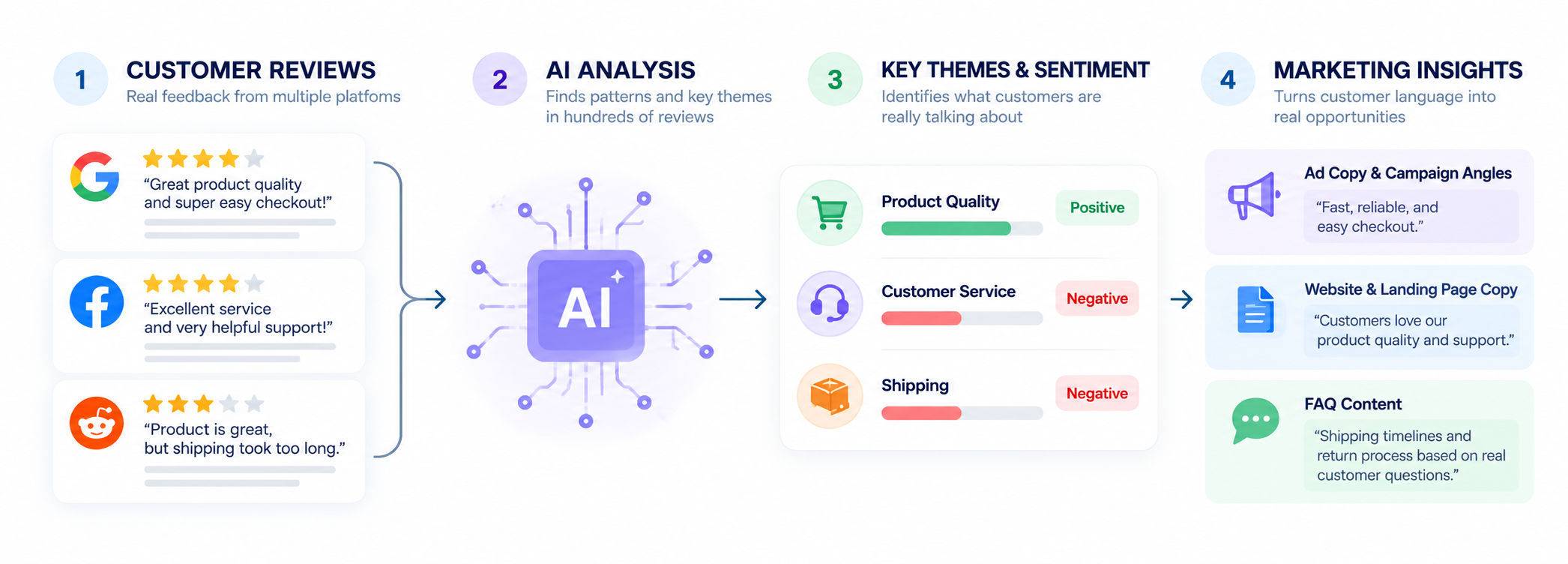
| 1. Brief the AI like a junior writer, not a vending machine | Feed it real customer language, competitive context, and the specific angle you want, not a blank product description prompt | Whether the output reflects your actual differentiation or defaults to generic price and urgency language |
| 2. Generate wide, then curate hard | Produce 15 to 20 variations covering genuinely different customer motivations, then cut to the 4 to 6 worth real budget | Whether the variations actually diverge in angle, or just reword the same claim |
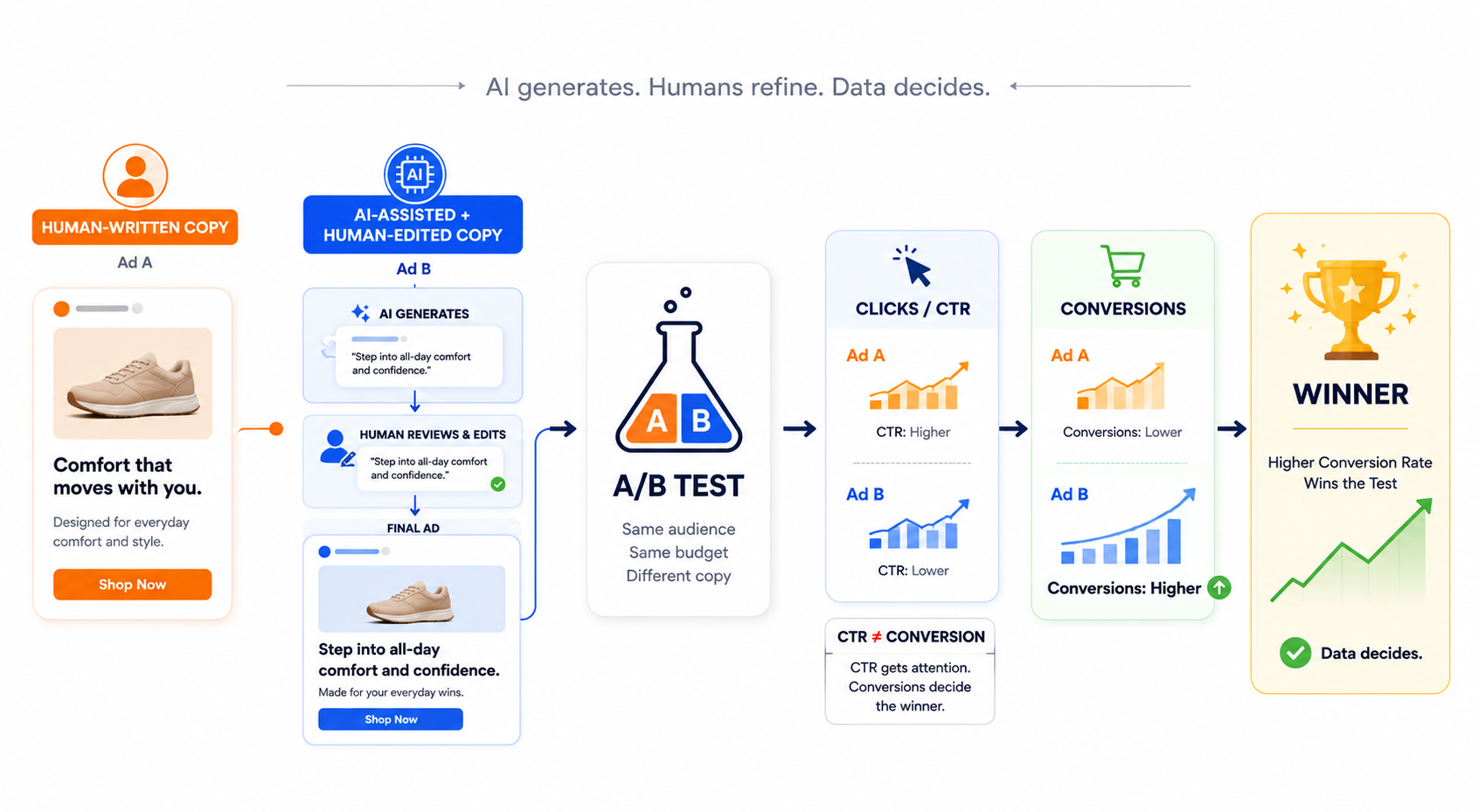
| 3. Run AI and human variants in the same test, blind | Rotate both sets through the same ad set with no internal labeling that could bias review | Raw performance without a bias toward defending either the copywriter or the tool |
| 4. Score on more than CTR | Track downstream conversion rate and, where possible, brand lift or recall, not just clicks | Whether a high-CTR AI variant is actually attracting qualified intent or just curiosity clicks |
| Asset Type | AI Performance vs. Human | Recommended Approach |
|---|---|---|
| Headline and description variations | Close to parity, often faster to find winners | Let AI generate volume, human curates the shortlist |
| Short-form video (under 6 seconds) | Comparable performance | AI-first production is reasonable, spot-check for the uncanny valley |
| Long-form video (15+ seconds) | Human wins by 19 to 28 points depending on the metric | Keep narrative and pacing human-led, use AI for variation and localization |
| Brand storytelling campaigns | Human wins meaningfully on recall and emotional engagement | Human-led concept, AI for testing and market adaptation only |
The pattern holding across every category here: the more strategic complexity an asset requires, the wider the performance gap between AI-only and human-written copy. Simple, structured formats are close to a coin flip. Complex persuasion assets aren't, and that gap translates directly into recall and revenue.
The pattern from running this framework repeatedly is consistent enough to predict in advance: a handful of AI-generated variants will beat the existing human copy on raw click-through rate, and usually only a fraction of those winners will hold up once you check the metric that actually matters. A headline can pull curiosity clicks from a segment that was never going to convert just as easily as it can pull qualified interest, and CTR alone can't tell the two apart.
The variants that hold up on downstream conversion share a specific trait: they're built from genuinely concrete input, a customer pain point pulled almost verbatim from a support ticket or a win-loss interview, not a generic prompt asking for "benefits-focused ad copy." That's the entire difference between AI output that performs and AI output that just looks like it's performing. A team that stops at CTR and scales the highest-clicking variant without checking trial signups or purchases downstream will, with some regularity, end up optimizing toward a number that looks like progress and isn't. The downstream check isn't optional diligence. It's the step that determines whether the test actually told you anything.
Pick one live ad set with enough volume to read results. Brief an AI tool with three real customer quotes and the single angle you want to test, generate 15 variations, and cut them to four. Rotate those against your current best two ads, unlabeled, with the same budget and audience.
Let it run until each variant has enough conversions to compare, then rank them on cost per conversion, not click-through rate. Keep whichever wins, AI or human, and write down what the winning line had in common with how your customers talk. That note is the brief for your next round.
We build ad creative for clients using exactly this hybrid model, including how we approach AI-assisted copywriting more broadly across content and creative work. Ready to find out what actually converts for your audience? Talk to us about ad copy testing and we'll help you build a structured AI-vs-human test on your next campaign.


.png)