Most accounts we audit are bleeding budget in the same three places: an audience setting fighting the algorithm instead of feeding it, a landing page built for a display ad instead of a click from a phone, and a lead form asking for more than the offer has earned. Fix those three and cost per lead usually drops before you touch a single bid.
Meta's own 2025 data backs up what we see in accounts every week. WordStream's 2025 Facebook Ads Benchmarks report found that average cost per lead on the platform climbed only about 2% year over year for Lead Ads campaigns, a modest increase compared to the double-digit jumps some other objectives saw, while click-through rate held steady. That combination tells you the auction isn't broken. The advertisers who lost ground mostly lost it to their own setup, not to Meta.
This article is a practical framework for how to reduce cost per lead on Meta Ads, not a listicle of generic tips. We'll walk through eight tactics that actually move cost per lead on Meta campaigns, in the order we'd apply them during an audit, along with the mistakes that quietly cancel out each one.
Three things are happening at once, and most teams are only reacting to one of them.
First, auction competition is up. More advertisers shifted budget into Meta's leads objective as third-party cookie deprecation pushed spend away from open-web display. More demand for the same inventory means higher CPMs, full stop.
Second, Meta's targeting stack has fundamentally changed. Advantage+ audience now treats almost everything you enter, interests, custom audiences, lookalikes, as a suggestion rather than a hard rule. According to Meta's Business Help Center, only location and minimum age remain strict constraints once Advantage+ audience is switched on. Advertisers still running campaigns like it's 2022, stacking narrow interest layers and expecting the system to respect them literally, are fighting the platform instead of using it.
Third, lead quality expectations are shifting. Sales teams that tolerated soft leads in a looser economy are pushing back harder now, which means more marketers are trading raw lead volume for pre-qualification, a trade that raises CPL on paper while lowering true cost per qualified lead. It's worth separating those two metrics before diagnosing a "CPL problem" that might actually be a lead quality improvement in disguise.
Key insight: Before optimizing anything, define what counts as a lead in your account, instant form, website form, or a gated call booking, because the friction level of that definition changes your baseline CPL more than almost any tactic on this list.
We apply these roughly in this order, because targeting and structure changes need time to season before creative or landing page tweaks can be judged fairly.
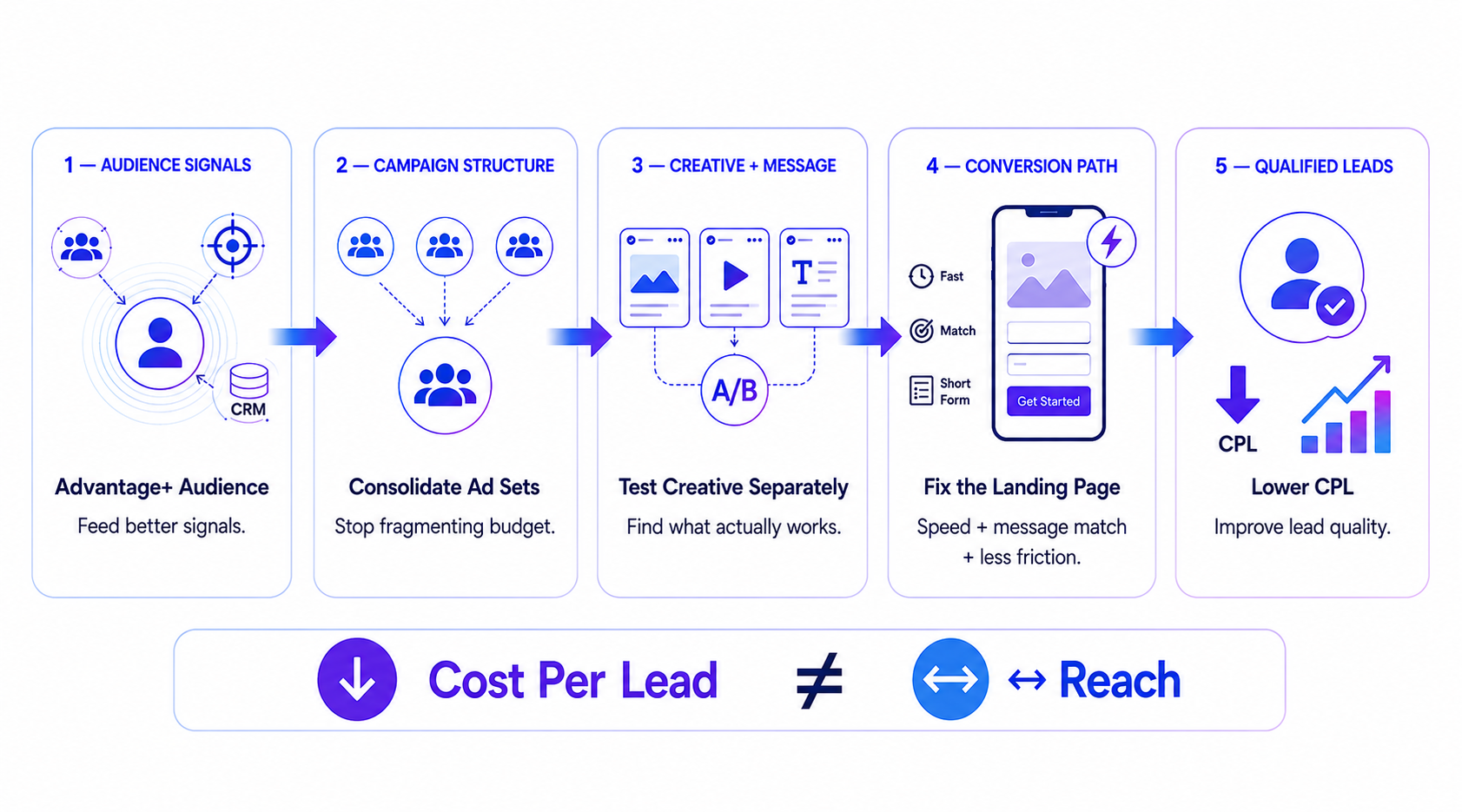
Fighting Advantage+ audience with narrow manual constraints is the single most common mistake we see in underperforming lead-gen accounts. The system was built to expand past your inputs when it predicts better performance, so treating your targeting field as a strict filter defeats its purpose.
The fix isn't "turn off targeting and hope." It's feeding the algorithm your best available signal:
Our Meta Advertising services page for a deeper walkthrough of our Advantage+ setup process
Splitting a $100/day budget across six narrow ad sets to "test audiences" was standard practice in the interest-stacking era. Under Advantage+, it mostly starves each ad set of the conversion volume the algorithm needs to exit the learning phase efficiently, which drives CPL up during a longer, noisier learning period.
Consolidate. One well-funded ad set with strong creative variety usually beats five thin ones. We generally recommend a minimum daily budget of roughly 10x your target CPL per ad set so the algorithm can exit learning within a normal week rather than resetting every time you touch it.
Running new creative and new targeting in the same test at the same time makes every result ambiguous. If CPL improves, you won't know whether it was the hook, the format, or the audience shift, which means you can't repeat the win on purpose.
| Test Type | What to Hold Constant | What to Change | Minimum Spend Before Reading Results |
|---|---|---|---|
| Creative test | Audience, budget, placement | Hook, format, thumbnail or first 3 seconds | ~50 leads or 3 to 5x target CPA |
| Audience test | Creative, budget, objective | Custom audience source, Advantage+ suggestion inputs | ~50 leads per ad set |
| Landing page test | Traffic source, offer, budget | Page layout, form length, headline | 1,000+ sessions or statistical significance |
| Offer test | Creative, audience, landing page | Lead magnet, incentive, form CTA copy | ~50 leads per variant |
This is the tactic teams skip most often, and it's usually the highest-leverage one. You can have flawless targeting and still post a mediocre CPL because the page after the click is working against you.
Speed matters more than almost anything else on the page. Research from digital marketing agency Portent, based on an analysis of millions of pageviews across B2B and B2C sites, found that pages loading in under one second convert roughly three times better than pages taking five seconds, and every additional second of load time in that early window compounds the drop-off. If your landing page is built on a heavy page-builder template with auto-playing video, that's very likely costing you leads before anyone even sees your offer.
Form length is the second lever. Unbounce's Conversion Benchmark Report, drawn from tens of thousands of landing pages, found a clear relationship between field count and completion rate: shorter forms convert meaningfully better, with the sharpest drop-off happening as forms move past three or four fields. Every field beyond name, email, and one qualifying question should have to earn its place.
Single call-to-action beats multiple. Pages with one focused CTA convert better than pages offering several competing links or actions, according to the same Unbounce dataset. Meta traffic lands better on a stripped-down page with no navigation than on a repurposed site page trying to serve two audiences at once.
Scent-matching sounds obvious and gets skipped constantly. If your ad promises "a free 20-minute audit" and the headline on the landing page says "Grow Your Business With Our Marketing Services," you've introduced a moment of doubt that costs you a percentage of clicks right at the top of the funnel.
Match the headline, the visual, and the offer language word for word where you can. This isn't a nice-to-have; it's the difference between a visitor who thinks "yes, this is what I clicked for" and one who bounces to double-check they're in the right place.
Meta's native lead forms remove almost all friction, which is exactly why they can both help and hurt you depending on your sales cycle. Instant forms tend to produce a lower CPL but a softer lead, since a user can submit in two taps without ever leaving the platform or fully engaging with your offer.
| Form Type | Typical CPL Impact | Typical Lead Quality | Best Fit |
|---|---|---|---|
| Meta Instant Form | Lower | Softer, higher volume | High-volume, low-ticket offers; top-of-funnel content |
| Website landing page form | Higher | Stronger intent signal | Higher-ticket B2B, sales-assisted funnels |
| Multi-step qualifying form | Moderate | Pre-qualified | Complex offers where fit matters (financial, legal, enterprise) |
If your sales team is drowning in unqualified instant-form leads, that's not a Meta problem, it's a form-type mismatch. Moving to a short multi-step website form or adding one qualifying question inside the instant form (budget range, timeline, company size) will raise your CPL on paper while lowering your cost per sales-qualified lead, which is the number that should actually matter to leadership.
Cold, broad Advantage+ audiences do the heavy lifting for volume, but your warmest pool, site visitors, form abandoners, video viewers past 50%, converts at a lower cost almost every time. Feed these as custom audience suggestions inside the same Advantage+ structure rather than running them as a fully separate, siloed campaign; this keeps signal flowing into one learning pool instead of splitting it.
A common mistake here: excluding converted leads too aggressively across every campaign, which shrinks your retargeting pool to the point where it can't generate enough volume to matter. Exclude leads from the specific campaign or offer they already converted on, not from your entire account.
We've walked into more than one account where the "CPL problem" was actually a measurement problem. Conversions API implementation gaps, deduplication issues between pixel and CAPI, or a lead form that isn't passing UTM parameters through to the CRM can all make Meta look more expensive than it actually is by undercounting the leads it's actually driving.
Before reallocating budget away from Meta, confirm:
Even teams that apply this framework well tend to trip on the same handful of habits:
The pattern shows up constantly in accounts running fragmented ad sets: six or eight narrow audiences, each getting a thin slice of daily budget, each individually too small to exit Advantage+'s learning phase efficiently. CPL climbs steadily even as creative gets refreshed, because the problem was never the creative. It was starving every ad set of the volume the algorithm needs to learn.
Consolidating that same budget into one or two well-funded ad sets, one cold Advantage+ audience seeded with a CRM list as a suggestion, one warm retargeting pool, typically doesn't cost reach the way advertisers fear it will. If anything, a consolidated structure usually finds more relevant volume than a fragmented one, because Advantage+ has enough signal in one place to actually optimize instead of guessing across several separate, data-starved pools. Pair that consolidation with a landing page rebuilt around a three-field form, a single CTA, and message match to the winning ad hook, and the CPL improvement compounds instead of coming from one lever alone.
The sales-side effect matters just as much as the media-side one. A form that asks one real screening question produces leads that are measurably easier to qualify than an instant form asking nothing beyond name and email, even when that extra field technically raises CPL on the account's own dashboard.
Start with the three checks that cost nothing. Load your landing page on a phone over cellular and time it. Count the form fields. Read the ad and the page headline side by side and see whether they make the same promise. Then open Ads Manager and count your ad sets: if any is funded below roughly 10 times your target CPL per day, merge it into another.
Fix whatever fails, leave the campaign alone for a full week so it can finish learning, and compare cost per qualified lead against the week before. Most accounts are missing two or three of the eight tactics, not all of them. If you want a second set of eyes on which ones, that's what a full paid media account review covers.
Ready to see where your account is leaking budget? Book a free Meta Ads performance audit and we'll walk through your account structure, landing pages, and attribution setup together. No cost, no obligation, just a clear list of what to fix first.


.png)