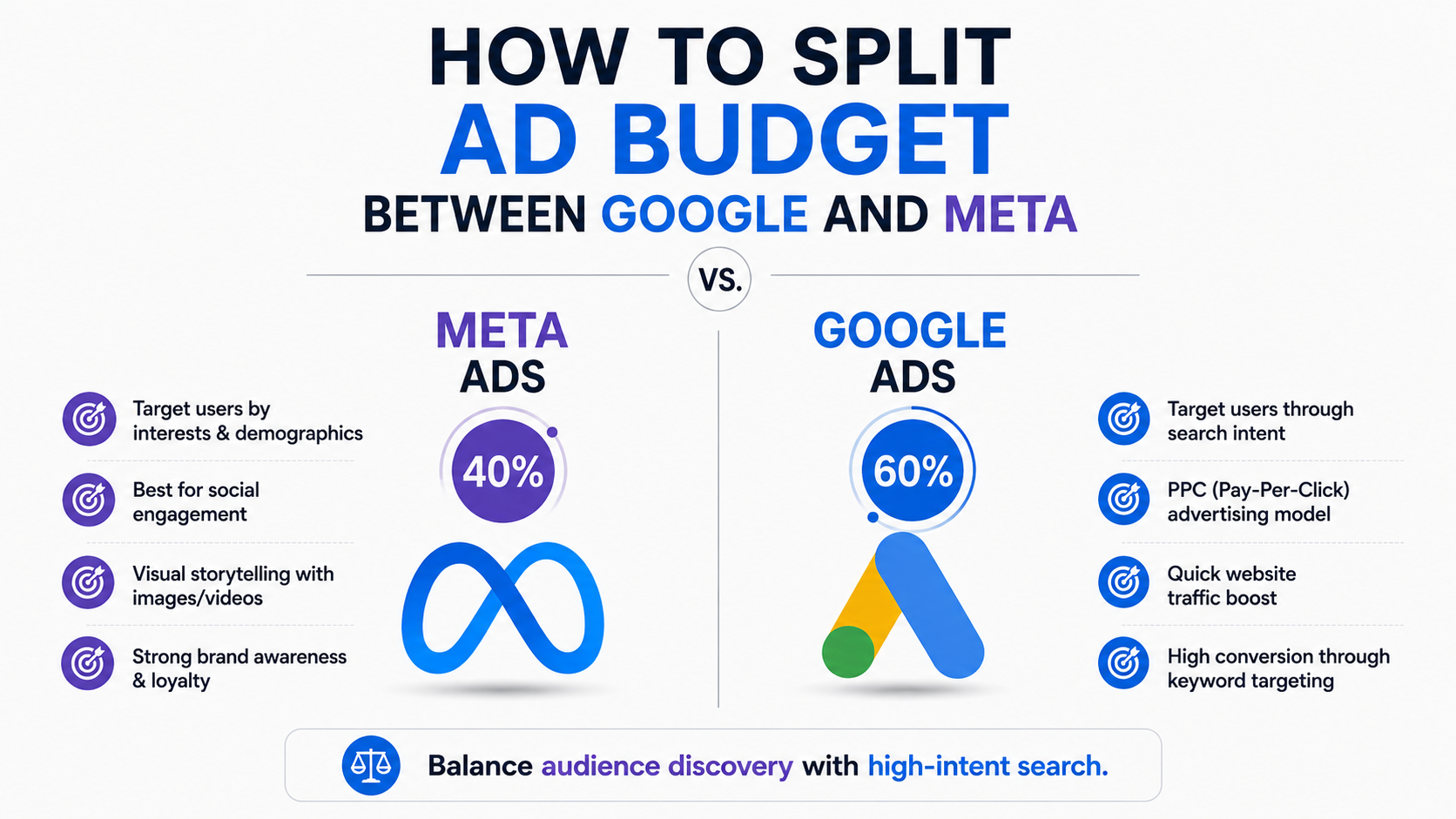
Most business owners managing their own ad spend ask the wrong first question. They ask "which platform performs better," when the honest answer is that Google and Meta aren't competing for the same job. Google Ads captures demand that already exists: someone typed a search because they want something right now. Meta Ads creates demand, or at least surfaces it, in front of people who weren't actively looking. Trying to decide how to split ad budget between Google and Meta based on which one has the lower cost-per-click is like deciding whether to rent a moving van or hire a taxi based only on the mileage rate. Wrong comparison. This article gives you the actual framework (based on funnel stage and business goal, not platform loyalty) for getting this allocation right.
Google and Meta are built on fundamentally different intent signals, and that difference should drive your entire paid media budget allocation, not a side note in it.
Google Ads is intent-based. A person searching "emergency plumber near me" or "best CRM for small business" has already identified a need and is actively evaluating solutions. You're not creating desire. You're capturing it at the moment it exists. That's why Google traffic converts at higher rates even though it typically costs more per click.
Meta Ads is interruption-based. Someone scrolling Instagram wasn't looking for you. Your ad has to earn attention against everything else competing for that scroll: friends' posts, entertainment, other ads. That's a harder job, which is why Meta creative has to work differently than search copy: it needs a hook, not just a value proposition.
Recent industry benchmarking makes the cost gap between these two intent types explicit. Analysis compiling WordStream and LocaliQ data found that average cost-per-click rose across 87% of industries on Google, with the overall average climbing nearly 13% year over year, while average cost-per-lead increased from roughly $66.69 in 2024 to $70.11 in 2025. Meta, by comparison, remains cheaper on a per-click basis but has been inflating fast on the impression side. Recent benchmark data put the average Meta CPM at $14.19 in 2026, up 20% from $11.82 the year prior, with average cost-per-acquisition rising 38.1% year over year to $38.19.
Key insight: Google is expensive because you're buying certainty. Meta is (relatively) cheap because you're buying a chance, and that chance has been getting more expensive too, just from a lower starting point.
Two things have changed the calculus recently, and both push toward more deliberate, funnel-based allocation instead of a rough 50/50 split.
First, both platforms have gotten meaningfully more expensive, which means an inefficient split now costs real money instead of just underperforming. Google's introduction of AI Max for Search campaigns changed bidding dynamics across the board. Reporting on the rollout noted that advertisers who activated the feature saw roughly 14% more conversions or conversion value at similar cost-per-acquisition and return-on-ad-spend compared to campaigns that hadn't turned it on, which means advertisers who haven't adjusted strategy are increasingly competing against accounts with a structural efficiency edge.
Second, channel preference among small businesses has shifted in a way that surprises a lot of owners. LocaliQ's most recent Small Business Marketing Trends Report found that social media advertising adoption reached 56% among surveyed small businesses, actually surpassing search advertising adoption at 45%, a reversal from where these numbers sat just a few years earlier. That doesn't mean social should get the bigger budget by default. It means more of your competitors are now running Meta campaigns without necessarily running them well, which changes what "good" looks like in your specific auction.
Zoom out and the scale of the decision becomes clearer: industry estimates compiled from eMarketer data put total worldwide digital ad spend at over $545 billion for 2025, with paid search and paid social together accounting for nearly 60% of that total. This isn't a niche allocation decision. It's the majority of where digital ad dollars actually go, and exactly the kind of decision we walk through in every Google Ads account audit we run.
We build every paid media budget around three funnel stages, and each stage has a natural platform bias. Ignoring that bias (running heavy Meta spend at the bottom of the funnel, or heavy Google spend at the top) is where most self-managed accounts leak money.
At this stage, your audience doesn't know they have the problem you solve, or doesn't know you exist as an option. Search volume for your offer may be low or nonexistent: there's nothing to "capture" yet. This is Meta's home turf: video, carousel, and Reels placements that introduce the problem and position your brand as the answer, aimed at cold or lookalike audiences.
Google plays a smaller supporting role here, mostly through Display and YouTube, for retargeting people who've already been exposed to your Meta content but haven't converted.
Here your prospect knows the category exists and is actively comparing options. This is exactly when Google Search starts to earn a bigger share of budget, because comparison-stage searches ("[competitor] vs [your category]", "best [category] for [use case]") are high-value, high-intent queries.
Meta still has a role: retargeting website visitors and warm audiences who've engaged with top-of-funnel content but haven't converted, using proof-focused creative (testimonials, case studies, comparisons) rather than pure awareness content.
This is where Google Search typically deserves the largest share of budget, because branded search and high-intent transactional queries convert at the highest rates of any paid channel most small businesses will touch. Someone searching your brand name or "[service] near me, book now" is as close to a buying decision as paid media gets.
Meta's bottom-funnel role narrows to tight retargeting (cart abandoners, form-starters, past customers for repeat purchase) rather than broad prospecting.
| Funnel Stage | Primary Platform | Secondary Platform | Typical Budget Split |
|---|---|---|---|
| Top of Funnel (Awareness) | Meta (Reels, video, carousel) | Google Display/YouTube (retargeting) | 70% Meta / 30% Google |
| Middle of Funnel (Consideration) | Google Search (comparison queries) | Meta (warm retargeting) | 55% Google / 45% Meta |
| Bottom of Funnel (Conversion) | Google Search (branded, transactional) | Meta (tight retargeting only) | 75% Google / 25% Meta |
This isn't a static formula you set once. As a campaign matures and your funnel fills in, the overall blended split naturally shifts toward Google, simply because more of your traffic is arriving with higher intent, the same funnel-mapping process behind every paid media strategy we build for a new client.
Before you touch next month's budget, run through this. Most owners we talk to can answer these instinctively once they're asked. The problem is nobody's asking.
| Question | If Yes | If No |
|---|---|---|
| Do people actively search for your product/service by name or category? | Google Search deserves a meaningful base budget | Lead with Meta to build category awareness first |
| Is your average sale price high enough to justify a longer consideration window? | Middle-funnel Meta retargeting is worth the spend | Push budget toward direct-response Google campaigns |
| Do you have retargeting audiences set up on both platforms? | You can run tight, efficient bottom-funnel campaigns | Fix tracking/pixels before scaling either platform |
| Is most of your current traffic cold (first-time visitors)? | You likely need more top-of-funnel Meta investment | Shift more budget toward Google's higher-intent traffic |
| Can you point to which platform is currently driving your lowest cost-per-acquisition? | Double down there, but don't defund the other entirely | You're not tracking well enough to allocate confidently — fix measurement first |
Mistake 1: Running Meta campaigns with Google-style copy. Direct, feature-focused ad copy that works in a Google Search result feels like an interruption in a Meta feed because it assumes intent that isn't there yet. Creative needs to earn attention before it can sell.
Mistake 2: Judging Google Ads by cost-per-click instead of cost-per-acquisition. Google will almost always look "expensive" next to Meta on a pure CPC basis. Recent benchmarking put Meta's all-industry average CPC at $0.78, versus Google's average landing well above $2 to $5 depending on the source and industry. But CPC in isolation ignores that Google traffic typically converts at a meaningfully higher rate, which is the number that actually determines whether the spend is working.
Mistake 3: Setting a permanent split and never revisiting it. We've seen owners lock in a 50/50 or 60/40 allocation the first month and never touch it again, even as their funnel matures and top-of-funnel Meta traffic starts converting through Google branded search weeks later. Attribution windows on both platforms undercount this cross-channel effect, so if you're not periodically reviewing blended performance, you're allocating on incomplete information.
Take a home services business spending $3,000 a month, split evenly between Google and Meta with no real strategy behind the split. Google Search is running broad-match keywords with no brand campaign, competing against every plumber and electrician in the metro for the same generic terms. Meta is running a single "book now" ad to a cold audience with no retargeting set up.
The Google spend is expensive because it's fighting for low-intent, high-competition keywords instead of owning cheap, high-converting branded and near-branded terms. The Meta spend is inefficient because it's asking a cold audience to book a service on the first impression, skipping the awareness step entirely.
The fix isn't reallocating the dollar amount. It's reallocating the job: move Google budget toward tighter, higher-intent keyword sets (including an always-on branded campaign, which is nearly always the highest-ROAS spend on the platform) and shift Meta toward top-of-funnel awareness content paired with a retargeting campaign that catches the traffic Google's ads generate but don't convert on the first click. Same total budget, structured around funnel stage instead of an even split. That's usually where the real performance gain sits, not in finding a cheaper platform.
It's worth being honest that the platforms aren't perfectly separable by funnel stage: both can work at multiple stages depending on format and targeting.
| Feature | Google Ads | Meta Ads |
|---|---|---|
| Best for | Capturing existing demand | Creating and surfacing new demand |
| Cost structure | Higher CPC, generally higher intent | Lower CPC, higher CPM inflation recently |
| Creative demands | Copy-driven, keyword-matched | Visual/video-driven, needs a hook |
| Measurement strength | Strong last-click attribution for search intent | Weaker attribution, especially post-iOS privacy changes |
| Where it struggles | Can't create demand that doesn't exist yet | Struggles to prove ROI on pure prospecting spend |
Export last month's campaigns from both platforms and label each one top, middle, or bottom of funnel. Add up spend by stage and compare it with the funnel table above. Two gaps show up most often: no always-on branded search campaign on Google, and no retargeting on Meta. Fix those before you move a dollar between platforms.
Then set a calendar reminder to rerun the exercise every 90 days and compare blended cost per acquisition, not cost per click. As more of your traffic arrives with intent, expect the split to drift toward Google.
Want a clear-eyed read on how your current Google and Meta spend is actually performing? Get a free paid media budget review, and we'll show you exactly where your dollars are working, where they're leaking, and how the split should shift based on your specific funnel, not a generic benchmark.