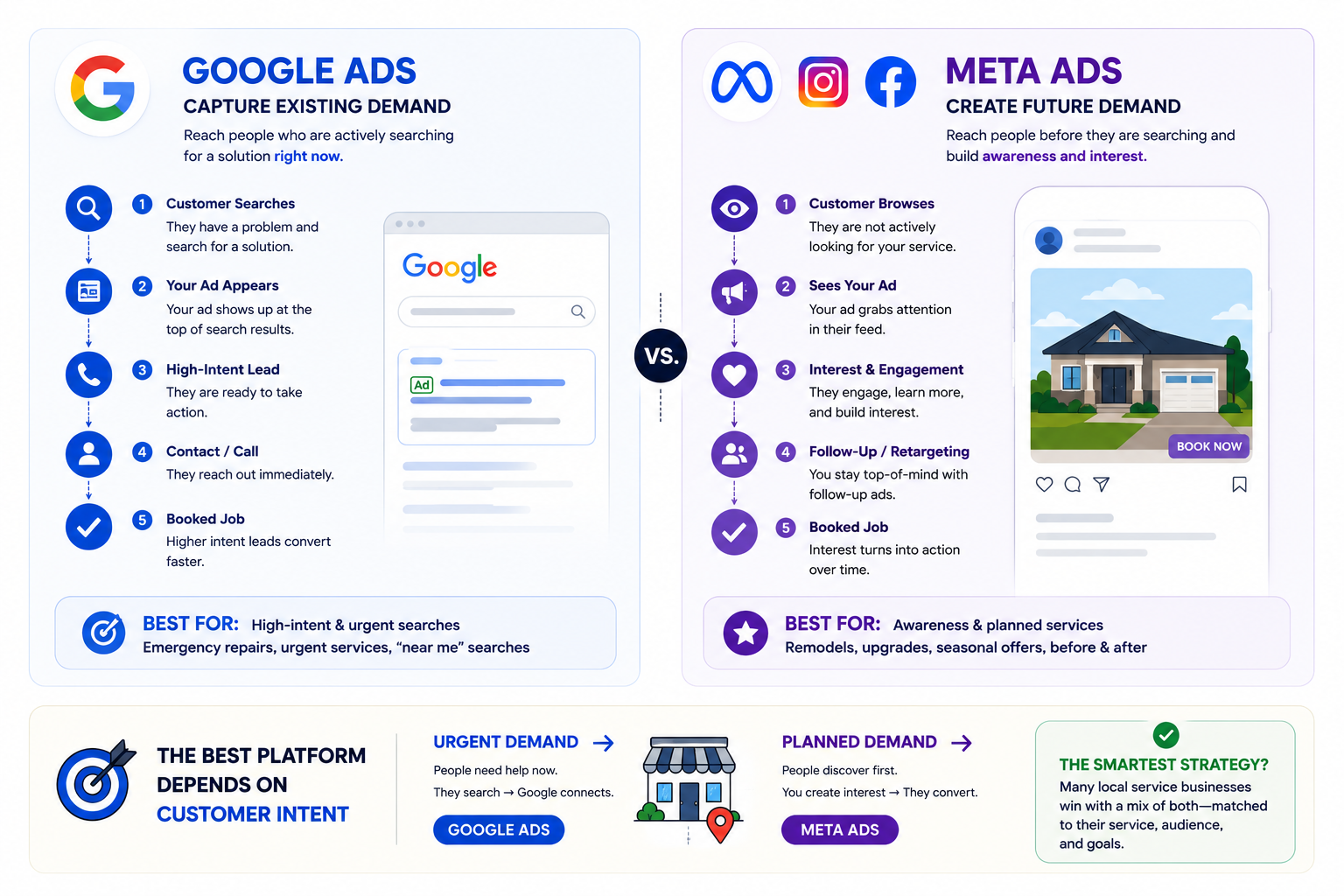
Ask ten different local service business owners which platform converts better and you'll get ten confident, contradictory answers, usually based on whichever channel happened to work last quarter. The honest answer is that Google Ads vs Meta Ads for a local service business isn't really a competition. It's a mismatch of jobs. Google Ads catches a customer who already has a problem and is actively looking for someone to fix it. Meta Ads creates that awareness before the problem becomes urgent enough to search for. Comparing their conversion rates head-to-head directly, the way most budget-limited advertisers try to, misses what each platform is actually built to do.
This comparison breaks down what the current cost and conversion data actually shows for local service businesses, where each platform genuinely wins, and how to build a local service business advertising mix that doesn't waste budget proving a point neither platform needs to prove. If you've been searching for a straight answer on Google Ads vs Meta Ads local service business performance, the honest one is below.
The instinct to pick a winner comes from a reasonable place: budgets are limited, and running both channels well takes more management time than running one channel alone. But "which converts better" assumes both platforms are competing for the same moment in a customer's decision, and they aren't.
Local search intent data makes the distinction clear. According to LocaliQ's 2026 benchmarking, roughly 46% of all Google searches now carry local intent, and separate research compiled from Google's own data shows 76% of people who perform a "near me" search visit a business within 24 hours. Someone typing "emergency plumber near me" has already decided to hire someone. They're choosing who, not whether.
Meta doesn't get that moment, and it isn't trying to. Nobody opens Instagram looking for a roofing contractor. A well-targeted Meta ad interrupts a scroll with a specific offer or story compelling enough to plant a seed, one that might convert immediately or might take three to five follow-up touches over the following weeks. That's not a weaker channel. It's an earlier one.
Current benchmarking data makes the practical trade-off concrete, even though the exact figures vary by source and should be treated as directional rather than gospel for your specific market.
Key insight: a cheaper Meta lead and a pricier Google lead aren't the same product. Comparing raw cost per lead across the two platforms without adjusting for intent and follow-up requirements is the single most common mistake we see local service business owners make when deciding where to spend.
Here's how the two platforms actually stack up across the factors that matter most to a budget-limited local service business.
| Factor | Google Ads | Meta Ads |
|---|---|---|
| Customer intent | High; the customer is actively searching for a solution right now | Low to moderate; the customer wasn't looking, you interrupted them |
| Typical local service CPL | $20 to $150 (Search); ~$53 average (Local Services Ads) | $10 to $50, trending upward, ~$27.66 average across categories in 2026 |
| Time to first lead | Fast, often same day once campaigns are live | Slower; needs budget and time to exit the learning phase before consistent flow |
| Follow-up requirement | Low; the lead is often ready to book within hours | High; often needs 3 to 5 touches before the lead converts |
| Best for | Emergency and time-sensitive services, categories with strong search volume | Discretionary or planned services, building a pipeline before demand peaks |
Stripping the debate down to PPC vs Facebook Ads for a moment, each platform has a clear structural advantage that doesn't disappear no matter how well you optimize the other one.
Google wins on categories where search volume and urgency are both high. Emergency plumbing, locksmiths, urgent HVAC repair, towing: these are searches with almost no browsing behavior attached. The person searching has a problem right now, and Google Ads or Local Services Ads put you directly in front of that moment. Trying to win this kind of demand with Meta means competing with the fact that nobody scrolls Instagram while their basement is flooding.
Meta wins on categories where the purchase is planned, discretionary, or driven by something the customer didn't know they needed until they saw it. Landscaping redesigns, kitchen remodels, spring HVAC tune-ups, med spa services: these benefit from a compelling before-and-after or a seasonal hook that creates demand rather than waiting to capture it. A well-run Meta campaign can build a pipeline for these categories weeks before the customer would ever think to search.
Rather than asking which platform converts better in the abstract, run your own service categories through these four questions before allocating budget. Most owners skip this step and default to whichever platform a competitor mentioned last, which is how budget ends up misallocated for months before anyone notices.
We walk new clients through a version of this exercise before recommending a channel split, and it's covered in more depth in our guide to allocating marketing budget across paid channels.
Once you've answered the four questions above, most budget-limited local service businesses need a starting point rather than a perfect formula. Here's the split we typically recommend when a business is testing both channels for the first time, treating it as a hypothesis to adjust after 60 to 90 days of real data rather than a permanent allocation.
For businesses with at least one genuinely urgent, high-search-volume category, we generally start closer to 60% Google, 40% Meta, weighted toward whichever category has the clearer search intent. For businesses where most services are planned or discretionary, with limited direct search volume, that ratio often flips toward 60% Meta, 40% Google, with Google spend concentrated on branded terms and whatever category-specific searches do exist. The point of this paid search vs paid social local business split isn't precision on day one. It's giving each channel enough budget to actually perform before you judge it, since underfunding either platform below its effective minimum guarantees a misleading result.
Track cost per booked job, not just cost per lead, across both channels from week one. That single metric adjustment resolves most of the "which platform is better" debates on its own, because it accounts for the intent and follow-up differences that a raw CPL comparison ignores entirely.
The pattern is common among local service businesses that picked a single platform based on CPC alone: Meta running exclusively, cheap leads on paper, often in the $20 to $30 range, and a close rate that quietly sits well under the account's blended average because a meaningful share of those leads are cold by the time anyone calls them back. The team ends up spending real hours chasing contacts who've forgotten why they filled out a form days earlier, and the cheap-lead math never accounts for that labor cost.
Layering in Google Local Services Ads specifically for the urgent, time-sensitive categories, emergency repair, same-day service calls, changes the shape of the account rather than just adding a second line item. LSA leads cost more individually, often more than double a cheap Meta lead, but close at a dramatically higher rate because the customer is already mid-decision when they call. Blended cost per booked job typically drops once each channel is running the category it's actually built for, even as the average CPL across the account rises, because the business stops paying for two different things with one metric. The shift isn't choosing a winner between Google and Meta. It's routing urgent demand to the channel built to capture it and planned demand to the channel built to create it, and letting each one do its job.
List every service you sell and mark each one urgent or planned. Check Google Keyword Planner for search volume on the urgent ones in your metro area, and put Google Search or Local Services Ads behind any that people search for by name. Give the planned services to Meta with a seasonal offer or a before-and-after.
Then add one column to your lead tracking: booked job, yes or no, by channel. Run the split for 60 to 90 days and compare cost per booked job, not cost per lead. That number tells you where the next dollar belongs.
Ready to figure out where your budget actually belongs? Book a free paid media channel strategy call and we'll walk through your service categories, local competition, and follow-up process to build a channel mix that fits your business.